
Episode 2: Systems Aren’t Tech. They’re Leadership Decisions.
If the word systems makes you want to shut down, you’re not alone.
For many solopreneurs, systems feel like code, software, automations, or tools you don’t have time to learn. And because of that, systems often get pushed to the bottom of the list until things feel completely out of control.
In this episode of The Solopreneur CEO Podcast, we’re reframing systems in a way that actually makes sense for real-life solopreneurs.
Systems aren’t tech.
They’re leadership decisions.
Listen to the Episode
In this episode, Carin and Marcia dive into one of the most misunderstood topics for solopreneurs: systems.
For many solopreneurs, systems feel like complicated tech, software they don’t have time to learn, or something they’ll “get to later.” In this conversation, Carin and Marcia reframe systems entirely and explain why systems are not about tools at all. They’re about leadership decisions.
They talk through why overwhelm often isn’t a time problem, but a structure problem. Why panic-buying tools rarely fixes anything. And how avoiding systems actually keeps solopreneurs stuck in reactive mode, carrying more mental and operational load than necessary.
You’ll hear real examples of how systems can support high-touch, human-centered businesses without removing the solopreneur from the work they love. The focus isn’t on automation for the sake of efficiency, but on designing a business that protects your energy, increases capacity, and creates resilience as you grow.
This episode is for solopreneurs who know their business shouldn’t feel this heavy and are ready to think differently about how it’s designed and led.
What We Talk About In This Episode
Why most solopreneurs resist systems and what that resistance is really costing them
The difference between tools and true systems
How panic-buying software creates more chaos instead of clarity
Why systems start with decisions, not tech
How to systemize without removing yourself from your business
The role systems play in reducing mental load and burnout
Why systems need regular check-ins to actually support growth
Key Takeaways
Systems are leadership decisions, not tech setups.
Overwhelm is often a signal that structure needs attention, not effort.
You don’t need more tools; you need clearer decisions.
High-touch businesses can be systemized without losing their human feel.
Strong systems create resilience so your business can grow without consuming you.
Continue the Conversation
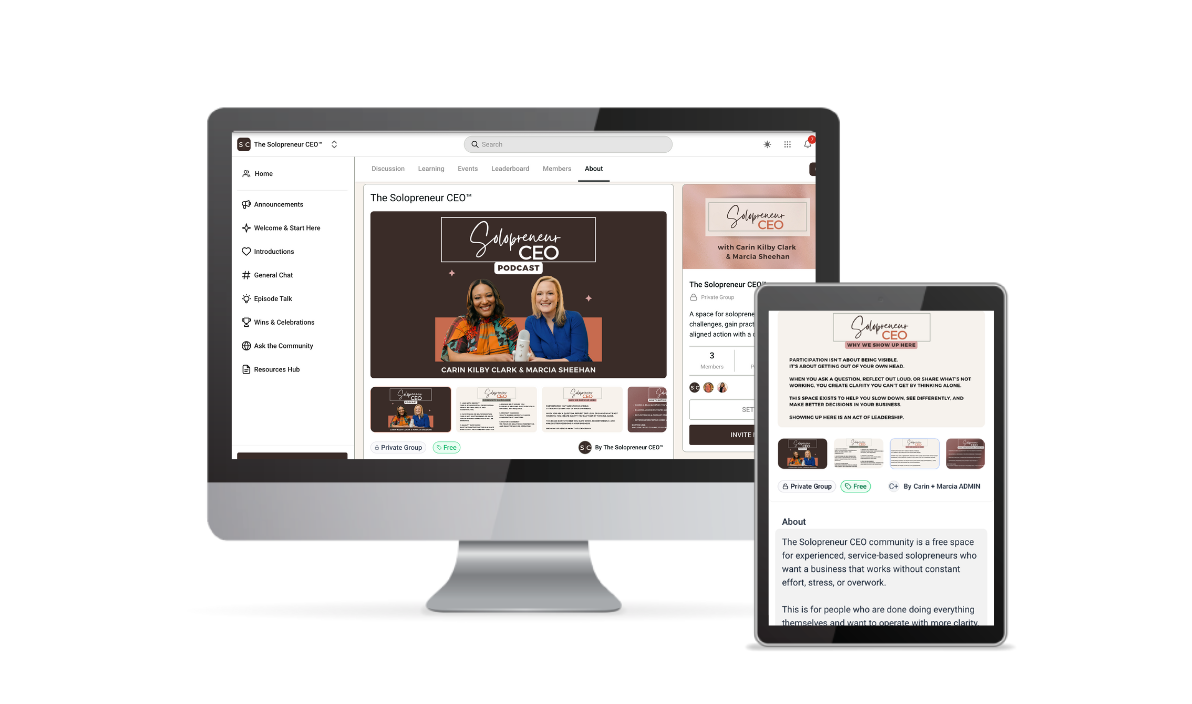
If this episode made you feel seen or helped something click, you’re invited to join our free Solopreneur CEO community.
It’s a low-noise space for solopreneurs who want support, honest conversation, and a better way to build a business that works without burning out.
Episode Transcript
Solopreneur CEO Show Episode 2: Below is the full transcript of this episode for those who prefer to read or want to revisit specific parts of the conversation.
===
Marcia Sheehan:
Welcome back. Today we're talking about systems. Hopefully you didn't, uh, turn us off. I have noticed with a lot of small business owners and solopreneurs that when they hear the word systems, there's kind of like a shutter where they're thinking, oh no, I don't need to have systems. I'm free spirited.
That's why I got into doing this. Like, I just do what needs to be done and there's always fires that need to be put out.
But that's what's gonna lead you to exhaustion. So systems are not just tech, you know, you don't have to associate it with anything other than making leadership decisions.
That's what a system is. It's deciding what needs to be done to prevent yourself from spinning out.
Am I right, Carin?
Carin Kilby Clark:
Absolutely. Most people when they think of systems, they do go straight to the tools like, you know, software automation platforms. But you're right, I mean, systems actually start with the decisions, decisions about workflows. Like what does what, like what steps are in your process that is, and how you can design it. That you don't have to actually manually do everything and so that, yeah. When you skip that part of like deciding and you just go straight into tech, I mean, you can get.
Really overwhelmed. And that's why so many people, I mean that's why AppSumo is like a billion dollar company because I think any solopreneur has heard of App Sumo. If not, go to app sumo.com. Do not buy anything. Just look at it. But, um, that's why it's so popular because you know, it's a company, a genius idea that will connect, you know, business owners with tools usually at a lifetime price. A special deal that's only available for a short amount of time. And it's usually these developers that have created tools that they want to like get to market. And when you create something like that, you need users because that's the only way to get feedback.
I mean, that's a lesson for us too, as solopreneurs, by the way. 'cause we will tinker and tinker and play around with our offers. Till the high heavens come out, but we haven't actually put it out there yet. The only way to really know an offer is gonna work is to get it out to the market.
And so that's what AppSumo helps those developers do, get it out to market. Um, and that's why it's so popular, because people will buy, we will buy tools and never even log in like. Or set up the account once and like look around, decide we're overwhelmed, and then check out, you know, like it's so common.
So if you are like nodding your head like, oh my God, yes, that's me. You are not alone. You have found your people here. So that's literally something that I think a lot of solopreneurs our clients have done. Like. It's very popular because the tool is the first thing you think is gonna solve your problem.
And so you see a tool, you're like, oh, that feature sounds like it would actually do what I need to do. But when you haven't actually made the decisions about how you want this to be structured and how you want it to flow, the tool is not gonna be the savior. Like you have to start there. And so, yeah. I'm so glad you brought that point up.
Marcia Sheehan:
You need to stop hating on AppSumo, Carin. Okay. No, uh, she just means for this situation, if you have not ever heard of them, check 'em out. 'cause like yeah, I have definitely, especially when I was a consultant for a marketing agency, I would panic buy things off of AppSumo because I was like, this is gonna solve all of my issues that I'm having right now because I was the only person in charge of certain accounts. And I was overwhelmed. And I was fearful, and so I was like, I'm just gonna throw some money at it and I'm gonna buy this thing 'cause AppSumo is gonna solve all my problems. But I have found many things that I've used, um, that have been very beneficial. The software that I purchase, if it's not fit into. It has to make sense what I'm using it for.
One of the things that I use, it's SendSpark and it's like a video. It's kind of like Loom or Vimeo where you can record your desktop or you can record a video, but then there's a button that people can click and you have the copy on the right or left or whatever. And so I would do that with personalized messages. That's how we got a couple of our Success Secret Society members was I sent them individual messages. I sent it in email, there's a little thumbnail and they clicked on it and it was like, “Hey, Name, I wanted to tell you that the doors are open.” and I got so many responses from that where people were like, oh my God, thank you so much for the personalized message. That was cool. You know?
It's great. It's effective. The ROI is amazing, especially since I think I paid 47 bucks for it and have like lifetime access and every iteration, like it's, it's just included in that one time fee I paid. And now I think it's 97 a month or something. So, but if I don't have like a system down for like, this is what I'm gonna do, like when doors are open, this is how I'm gonna approach it.
I'm gonna send a DM and then I'm gonna follow that up with an email, video or whatever. Then it doesn't make any sense. So like you are kind of just throwing money away. So. Buy the tools if you need them. Don't buy them to solve your problems. But think about what Carin said, like what do I need to do to make this effective?
And then do that.
Carin Kilby Clark:
Yeah. No, I mean that's a perfect like ending sentence for that little like that thought is like buy the tool to execute the decision you've made on how you want this to work. Like so if you decided this is the process and this tool will help you execute that process. Boom, good. But when you just kinda panic buy different things 'cause you think it's gonna solve a problem, but you haven't fully mapped out what you're trying, what you're trying to do, and made a decision on how it's gonna work, you end up with a tool graveyard that, you know, you're like, why did I even buy this?
This was such a waste of money. Or at the end of year, when you're doing taxes, which, you know, at this time of this episode, uh, probably a lot of people are in that mode. Um, you're kind of like, why did I buy that? What did I even do? I didn't even use that. And then you kind of have the guilt, right?
The guilt that comes with overspending on things that didn't actually help you. I mean, it just can turn, it turns into a spiral. So to avoid that, you do wanna start with like, just thinking through how you want. The business to operate how you want your processes to flow, and then what tools can help you execute that without, and especially when they can take the manual work out of it, you know, like where you don't have to do, like Marcia was able to use that SendSpark tool to like create the video.
And it easily would email it to the person and let them watch it and they could respond. Like all of that could happen in the tool, and she didn't have to take additional actions. Like that's the kind of stuff you want to think about and decide how you want it to work is minimal involvement with you manually as needed.
And if it is something that requires you to be fully in, that's fine too. But that's a decision. It is a conscious decision. It's not like you're just doing that because you don't know a better way or you haven't really thought it through and you're just kind of doing stuff. That's what we want you to avoid.
Marcia Sheehan:
Yeah. You're never gonna regret spending time at the beginning of exerting effort because considering what is going to be the best course of action, unless of course you're using that as a way to procrastinate and not actually get out whatever you need to get out. But like you wanna think about like the user experience on the user's end, but then also for you as well.
That's what the systems are gonna do, is they're gonna help with your energy, they're gonna help with your accessibility too. Me sending that was friendly and it was warm. And for the people who were ready to join right away, they're like, oh, I know this girl. I've worked with her before.
She's amazing. She's great at communities. I'm gonna click and apply right now. They could do that. And then the other people who were like I'm not sure if this is a perfect fit for me or whatever. 'cause like these, these recordings I did were like 30 seconds or whatever.
Like it was a whole psychological, it was the system that I created for this, the system I, um, I was like, I just wanted to be like a quick, you know, that was the purpose of the, the video was to be thoughtful. Um, and so you need to think that stuff through and then push it out.
Carin Kilby Clark:
What I like is we're talking about you don't have to remove yourself from the business to have systems. Like I think sometimes people will be like, well, if I have a system set up and then I'm not involved. Like I remember helping a client who, her business was very high touch. She was a doula.
So I don't think you get more high touch than helping somebody deliver their baby. Like that is like super, I gotta be there with you. But when she would get new clients, like there was this whole educational process and like the whole onboarding, you know, of the client was very intense and it required so much time from her that she was self-sabotaging, getting new clients because she's like, I can't handle doing three onboardings right now. So I'm just not even gonna, you know, she had people who were like, I'm about to have a baby, you know, help me out. And she's like, oh, I can't, let me refer you. And I'm like, but why? You know? So anyway, we dug into all of that and at the end of the day it's like, no, you can a hundred percent systematize this and this is how you can stay involved.
Like, you know, we went through that and we ended up creating an onboarding process. That like someone could sign up, you know, they paid the fee and signed all the things they had to sign, the contracts, whatever, and then there's this whole process kicked off and they felt very handheld by her the entire time through the process.
But she didn't have to manually or physically show up for anything. It was all automated. It was a lot of video involved, but like it made people feel like she's right here with me, walking me through this, helping me out. But it didn't require any time from her. And next thing you know, she, I think it was like 90 days later and she had like five more clients and she's like, this has never been better.
Like, I'm like, she was so happy. And tho that seems so simple, but it made. Such a difference in how her business was operating. And it started with the decision like, this is how I want the process to flow. This is how I want them to feel. This is what I want them to receive, but do I have to physically show up on a Zoom call to do that and be on there for hours answering questions that are pretty much standard?
I mean, yes, everyone's. You know, body can be a little, you know, the way they react to the process of pregnancy and delivery is a little different and everybody has their own birth plan, all that stuff. But having a baby is kind of like, this is how it works, right? It's not gonna be, but so different for each person.
So like a lot of what she was going over in like a three hour zoom call, because the person has so many questions and she's not gonna be like, well that's it, it's six 60 minutes is over, you know, and hang up. But she was able to like really create a process that answered all their questions. And then if they still had other ones, you know, that are really specific, there was a way to get that.
But the point is like, it didn't remove her from the process, but it created a system that. She could actually take on more clients than she ever thought she could have at the same time, because she had these systems in place. And so that's kind of the stuff that, you know, we're talking about with systems and how that's a leadership choice and how you're leading the business.
And being an owner instead of an operator. And that's, you know, that's really what the systems come down to. And so it doesn't matter what the system is, what the tool is, it really matters what your vision is and what, how you want everything to work.
Marcia Sheehan:
I love it. Just being able to release that mental load of thinking, you know, you, you have a lead and they're engaged. And then once that happens, there's excitement and everything. But like knowing that whatever system you put in place is working behind the scenes that releases so much of your brain bandwidth. Like you don't have to think like, oh shit, well I need them to
Once they send in the non-disclosure, then I need to send the payment link, like Carin set all that up behind the scenes for the society. So it's like, it's so succinct, like, you know, we get an email with the application and so we do read them through together and then we discuss and everything. But that's part of, I mean, we don't wanna just, you know, quickly approve anyone into the membership.
Um, so that's by design. But so we have that, and then once we both decide, then it kicks off this whole. We click, we physically move it over. I love that video. By the way, the screen recording we did like of our first accepting our first member back in, was it July or August anyway, whatever. 2025. Um, so it's like we move that over and then it kicks off everything.
We want people as soon as like, I think for our members, because they are all solopreneurs and experts in their fields, we wanted to be very succinct and very clear. And so that is how we communicate like we're I. We believe in brevity. I get all of my words out on the podcast and on my blog, you know, but like, when it comes to like the member, the membership, we want people to know immediately, like, this is what I need to do.
A, b, c, click, click, click. You know, and then there you go. And you're in a supportive community. So, um, yeah. But like, just. Having that where we don't have to think like, okay, Carin, did you send the approval to this person? Okay, well, I'm gonna send an email and just say like, Hey, did you have a chance to check out the NDA, blah blah, blah?
And so there are so many different touch points that you can, you can have if you, if being thoughtful and handholding is like part of your brand. Your ethos for your business. You can have on every single communication that you put out, you know, book a 15 minute call with me or something like that. You know, where it's conveying that you're available to help them in any way they may need, but like keep it at 15 minutes so that they know that there's boundaries, you know, and like maybe have it in your like onboarding contract or something that says like, you know, you get up to four of these a month or whatever.
But I was just thinking about your doula and it's like, pregnant ladies can be. A situation. I've been pregnant a couple times and I was a situation, so like, you know, make sure that the systems are keeping that in mind too, just to prevent, um, any issues from coming up later down the road. But, um, yeah, I, I've been like excited about talking about this because when we were discussing the episode before we hit record.
I thought of a friend who I have, who she used like an automated CRM for, like people, um, people that were looking to hire her service. I'm trying not to give any I identifying. Uh. Any, whatever identifiers, but basically she had the CRM that was supposed to send out everything, you know, and it was supposed to be like, okay, one and done.
Like as soon as somebody applies or submits a request or whatever, this is how it's gonna happen. She had it going for like two months and it was broken. The system was broken. So I think it sent out like the first email. And so. Your systems need a system, meaning you need to always be checking in and make sure that there aren't broken parts of the process because that will screw you up so much.
Because I know for her, she, you know, we have regular coffee dates and she was just like, the amount of guilt I felt about that and the amount of shame and it's like I'm running this like, you know, seven figure company. I have people who were reaching out, requesting my service and not her service, like she has provider, whatever.
So, um, but she's like, and they were freaking ghosted because I thought this thing was working in the background and it was not in fact working. So. We don't want you to have that mental drama either. So like create the systems and it's the same with ai. Like you wanna be checking on these things. Like you always need to have the human involved, especially in the beginning, but periodically like just put it, maybe not quarterly, but like, you know, once a month, like on one of your CEO days where you're just doing the administration type stuff.
Just make sure like that whatever tools you're using, that it's actually working.
Carin Kilby Clark:
Yeah, no, that is very important because systems are not meant to make your business like rigid or you know, like I'm locked in and boxed in. The real point of the system is to make your business resilient.
You wanna have faith in that, you wanna know that it's working. You wanna know that it's actually doing what you intended for it to do. So I, I love that you brought in the CEO day and just checking on those systems like at least once a month. There are always tech hiccups and if you have someone, you know, sometimes you might have a contractor that does that for you, whatever.
If it's you or a contractor, a va, it's just important that there are eyeballs, human eyeballs, that are making sure emails are firing and workflows are connecting. And you know, we use a system, that's built on high level. So it's kind of like a all in one, which is beautiful because we don't have to duct tape a bunch of things together.
We don't have to worry about if this system talked to the other system, like it's all in one system, which is nice. That can be a risk too. I mean, some people are averse to that 'cause they're like, I don't want everything in one place. 'cause if that goes down, then everything, I mean, there's pros and cons to everything.
You know, you'll hear us say a lot of times on this podcast that everything works. So just find what works for you. For us having an all-in-one is what's most comfortable for us and it's a very reliable, all-in-one system. So we're, we're okay with that, but. I still check on it. Marcia still checks on it.
Like we have to make sure emails went out. I mean, for a while we were on our own email list, you know, I did take us off 'cause we were like paying 1 cents an email and I was like, why are we paying to send ourselves a message? But anyway, but the point is like, we wanna make sure that emails went out. So you know, we have to just make sure that things are working and that's part of being a business owner.
You can't ever really escape that. The point of the system and setting up the structures in your business is so that you do have resilience and that you can grow, that it's not a chaotic growth. You know that you can grow comfortably and sustainably because you have a strong foundation and you have a strong backbone for the business to grow on with your systems and your tools and processes.
So it is not something that you can do. It's not something you cannot do. Like you kind of have to have systems and systems for your systems and check-ins with your systems, but it's not, again, meant to box you in. It really is meant to just be the thing that sustains you as you grow as big as you want to be.
I don't, you know, you could be growing. To any certain revenue number or maybe you have a certain client threshold, whatever your targets are, like, your business should be able to help you get there in a way that doesn't kill you in the process or make you feel like burning it all down or like you're living in chaos.
Like that's just not a healthy place. So that's why we are so passionate about having the systems that can help you get there without, without all that.
Marcia Sheehan:
Yeah. And I will say like the fact that we got started in the stone ages, you know, back in 2012, 2013, um, everything was kind of disjointed. But then you have these developers who are like, what are people's pain points?
Like what, what can help these entrepreneurs succeed? You know? And so the fact that we're able to have that. Software where everything is housed in it. Like for me, you know, 'cause Carin's our systems person, so she'll be putting stuff together and like I realized like, oh, you know, I said, oh, so this is here?
And she's like, yeah. And I'm like, and this is here. And she's like, yeah. And I'm like. Oh, so I can be doing, 'cause I, you know, I, I wanna contribute, like, I want this to be like a, you know, equal partnership. And so I was like, oh, well I can do this part and I can do that. So we created a system for me to be involved in the software, which, you know, it's, it is kind of intimidating for me and I'm also the type of person where I'm like, I hate doing something if I have to do it one time, like, unless I'm getting paid for it, you know, obviously, like I'll go in and help small businesses with like their SOPs and their CRMs and all of that type of stuff. But like for me, it's like if I'm doing it one time for my business to get it set up, I'm like, you know, like I just, I don't know, I, my brain just kind of it, it doesn't really like it. So, but anyway, so like, but the fact that like everything is so succinct now and it all works together and it all connects, like yeah, there is that little bit of fear like, oh no, like what if it goes down or something? And then it's like, you know what, if it goes down, we still have our email, we have our Google Drive, like there, we have everything backed up in a different way.
So like worst case scenario, we have to set stuff up, but. That's fine. That's just part of it, you know, but like, we're not gonna just bo jangle it until the end of time because we're afraid that the software is gonna stop working. You know, like you just move on. Like, you just figure it out. So, yeah, I, um, I, yeah, systems, systems are good.
Having that forethought, um, and making those decisions. It's gonna help you out, especially like if you've been in business because like in the beginning when you first get started, you're going just on like adrenaline and grit and hustle and excitement. 'cause people are paying you for something that you are bringing to them that's bringing value to their life or their business or whatever.
So you're, you're going off of that pure blissful energy of being like a young budding entrepreneur. But once you have been in business for a long time and you know that things aren't working, like there are people that can help you with that. You know, and there's software and, and tools that can help you with that.
So, you know, we want you to reach your full capacity, whatever that image is that you have. Like if you feel like things are broken. Or they could be working better or you're saying no to clients because you don't have the capacity it could be a system issue. And so, you know we're hireable. You can hire us, we can do a one-on-one or a two-on-one or whatever, like, or you can join our community.
We have a free online community at thesolopreneurceo.com. You can join the free community. You can become a society member. We do hot seat coaching. Like there's, there's so many options, but like, don't just stay stuck because you're like, this is too overwhelming. 'cause like, we need to talk to people. We need to say like, this is what I want.
You know? Or just like, Hey, this is how I've been doing it. How can I do it better? And then you do it one time and then it's done. Or you hire someone to do it for you one time and then it's done and then you check on it.
Carin Kilby Clark:
Yeah. Gotta check on it. Don't forget the check on it part. No, I love that. 'cause it really is like it, it can, they don't have to feel, it doesn't have to be heavy or intimidating.
Right. That's the bottom line. Like, systems don't have to feel heavy or intimidating or like something that is like. You know, a new concept that you're like, oh hell no, I'm not doing that. I'm not getting in that. So we, and you don't have to do everything at once. It can feel very overwhelming when you're like, okay, fine, I need systems, but where am I supposed to start?
You know? And so you just have to really think about those decisions like we talked about earlier. And then design your processes and then go from there. Then you start to figure out what tools, what kind of SOP will help you execute. Like that's really the best place to start. And you don't need fancy tools.
I mean, you really don't. I mean, it can be very simple tools. I mean, it could be just a better way to use your Google, your Google Drive, or your, you know, like it can be simple, it can be complicated. It could be whatever you want it to be, but you just have to start to make the decisions and, and figure out what's gonna work best for you.
Marcia Sheehan:
Yep. Create that lean, mean systematized machine. Such a dork. Seriously. Like, you know, it's like just create those systems so that you're able to conserve your energy and be in that CEO role of leading your business as opposed to constantly having that tornado of doom spinning in your head.
Like, what am I missing? Like what Carin said, you don't eat an elephant all at once, like in one bite, like you take bites out of it. So that's the quarterly planning workshops that we do. Um. It's helpful 'cause it's like, okay, I'm gonna focus on that in the next three months.
You know, like we can do anything in three months. So yeah, just the first thing is admitting that you have an addiction to not having systems and then, and then we take it from there. All right. Well we'll see you next week.