Episode 20: Building a Values-Driven Business with Tara Whitaker (Part 1)
There’s a version of entrepreneurship that looks exciting from the outside.
Freedom. Flexibility. Creativity. Being your own boss.
But once you’re actually in it…
you realize how much of building a business is really about figuring out who you are, what matters to you, and how you want to work.
Because when you’re the one making the decisions, setting the direction, and shaping the experience…
your business becomes deeply personal.
And sometimes that means questioning things that used to feel straightforward.
Like visibility.
Success.
Community.
Even the way you think about work itself.
Listen to the Episode
In Part 1 of this episode of our How I Run This series, Marcia sits down with Tara Whitaker, book editor, coach, membership founder, and host of the Modern Editor Podcast.
This is a thoughtful, wide-ranging conversation about entrepreneurship, values, visibility, creative work, and what it actually looks like to build a business that reflects who you are.
What We Talk About In This Episode
Tara’s transition from corporate event planning into entrepreneurship
How the pandemic reshaped the way she thought about work and business
Why visibility can feel emotionally complicated for women business owners
Building a values-driven business instead of chasing external expectations
The role of community and connection in solopreneurship
Honest thoughts on AI, creativity, and critical thinking
What it means to create work that feels aligned with your real life
Key Takeaways
Building a business forces you to get clear on your values
Visibility is often more emotional than strategic
Community can play a major role in sustainable entrepreneurship
You don’t have to build your business the way everyone else does
Alignment affects not only your work, but how your business feels to run
Creative entrepreneurship requires both self-awareness and intentional decision-making
Continue the Conversation
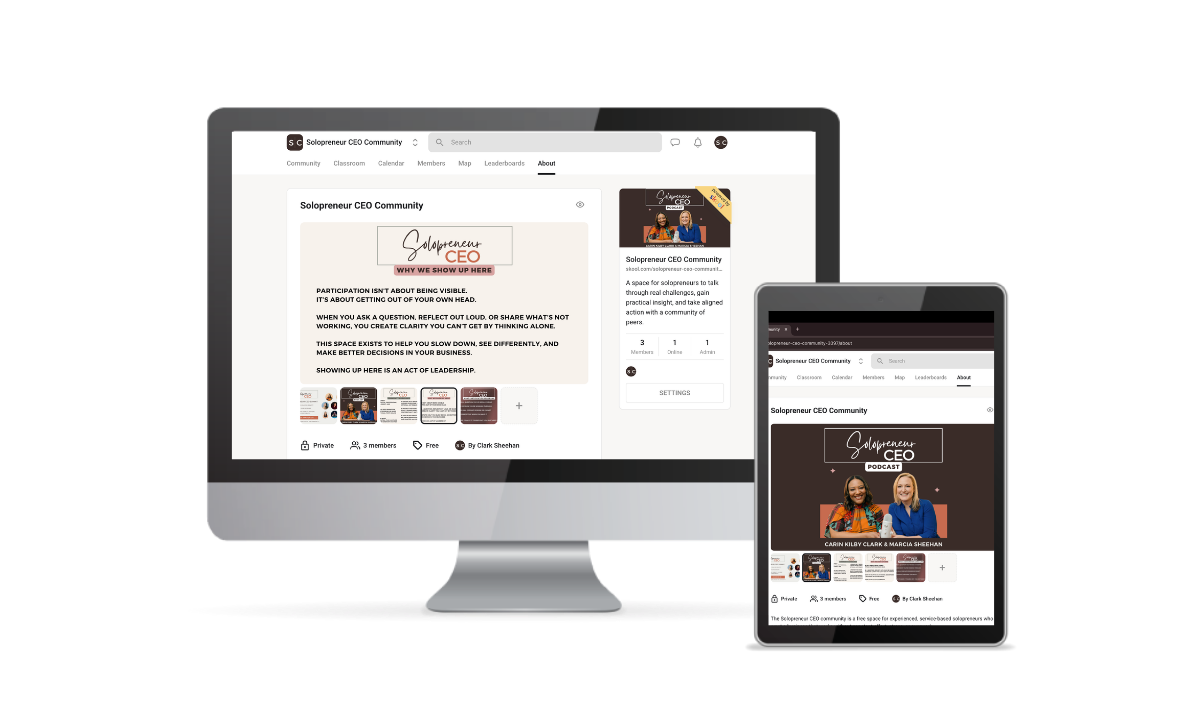
If this conversation resonated with you… you’re not the only one. This is exactly the kind of conversation we’re having inside the community every day.
👉 Join us here: https://thesolopreneurceo.com
A space for solopreneurs who are building real businesses and want camaraderie, perspective, and real conversations along the way.
Episode Transcript
Solopreneur CEO Show Episode 20: Below is the full transcript of this episode for those who prefer to read or want to revisit specific parts of the conversation.
===
Carin: Welcome to the Solopreneur CEO podcast. I'm Carin Kilby Clark, and along with my co-host Marcia Sheehan, we help solopreneurs lead with clarity and build businesses that grow without burnout. This show is for solopreneurs who've built something real, but are carrying more of the load than they want to be.
Carin: Your business works, but it depends too heavily on you and deep down, you know it shouldn't feel this hard. Here we talk about the mindset, systems, structure, and support it actually takes to run a business without sacrificing your wellbeing. We are not about hustle culture or pushing harder just to survive.
Carin: This podcast is about stepping out of reactive solopreneur mode and into CEO level leadership so your business can support your life instead of consuming it. If you are ready for honest conversations, real world strategies, and a lot less pretending you are in the right place. Let's get started.
Marcia: Hello. Welcome back. I am so excited to have another episode of the How I Run This series. I have Tara Whittaker here with me. I met her back in maybe 2015. No, maybe it was 2018. We met at the, um...
Marcia: Amanda Boleyn. She Did It Her Way. Yeah.
Tara: I had a kid. So it must have been 2018 or 2019.
Marcia: We're almost going on a decade, and we have yet- Ooh ... to meet in person, which is insane.
Marcia: Like, come on. I know. I know you're gonna be in the DC area or- Mm ... I'll be in the area. Am I though? Yeah, actually, maybe in, like, three years. Yeah, uh- Maybe you're
Tara: gonna be in the Chicago area.
Marcia: Yeah, yeah, yeah. Maybe. I just wanted to introduce you to Tara and find out a little bit about her business because she has a membership. She's solo, and I think she wants to stay that way, but we'll find out in this episode.
Marcia: Mm. So go ahead and introduce yourself. Tell us a little bit about why you became a solopreneur, because I didn't realize until I hired you with, like, a coaching package, um, that you were actually in events. So that was when I had- Yes ... my, my fundraising job and you were like, "Oh, okay, so you knew a lot about events" and I was like, "Oh, this is great."
Marcia: Like, I was just hiring you 'cause I was trying to keep my foot in the entrepreneur pool. So, yeah. So just give us, like, a rundown of maybe, like, the past... Yeah, you've been solo for, like, what? 12 to th- 12, 14 years, so.
Tara: 14. I know, 14 years.
Marcia: Yeah. Yeah. It's been a minute. So give us a recap of the past 20 years then.
Tara: Okay. No pressure, and let me make this semi-brief. Like Marcia said, I'm Tara Whittaker. My pronouns are she, her, and I have been a solopreneur for 14 years. Math is not my forte, words are, so don't hold me to that specifically, but I did. I started out my career post-college as an event planner or a meeting planner, and- enjoyed it, but, knew that it wasn't going to be a long-term fit.
Tara: And so I was always the person that found typos in everything and I've been an avid reader all my life. And then I was tasked, because I was the youngest person at my job as an event planner, to do the website. 'Cause apparently if you were young, you knew how to build a website. And I was like, "I have no idea what I'm doing."
Tara: But I learned some basic HTML. I started writing some things and was like, "Oh, maybe this is my next move." So I moved to another job where I was a content manager for a luxury hotel chain. Also realized, loved the people I worked with, am still very good friends with a lot of them, but corporate life was not for me, and it was not going to work out.
Tara: The commute that I romanticized when I was in college was getting old. The politics, the office politics, the drama, the stupid rules, the da, da, da. So I'm like, "Okay, this is not gonna work." So I started a book blog as a creative outlet off of a friend's recommendation I knew in college.
Tara: That got me on Twitter. Remember Twitter? Like, actual Twitter.
Marcia: I loved Twitter. That's where- I know ... I found out about Michael Jackson, and, like, that was my news source. Yes. And then now it's like we're just spoon-fed news 24/7- Yep ... which I hate, by the way. Yeah. But yeah, Twitter back in the day, like, you could connect directly with authors.
Marcia: Oh. They would tweet you back. Oh my God, it was so beautiful. Yes, yes. I was like, "Oh my God." Uh, James Altucher, like, tweeted me, and I was like- Ooh ... well, I mean, I tweeted him first. Slay. But, like, I, I was just like, "This is the freaking coolest platform ever," and then it got weird.
Tara: Uh, well, yeah. It did. It connected you with people who you never thought you would be able to connect with.
Tara: And so I got on the Twitter and I got my first unpaid internship at a publishing house because an editor tweeted they needed help, and that literally started my entire career in editing. And that was 14 years ... It was October 2012 is when I started my side gig. I lasted five months until February 2013 before I quit my full-time job because it was so toxic and so not great.
Tara: It was probably before I should have quit, financially. But this is pre-kids, pre-marriage, pre-house ownership. I had some flexibility. Here I am 14 years later. I'm still a book editor, but I've also added on, like you mentioned, I have a membership community called the Freelance Editors' Club.
Tara: I learned how to coach, so I also offer coaching for freelance editors. And then I host the Modern Editor Podcast. So that's all happened within the last six years. So it's been a busy time. But I love it.
Marcia: I love it for you too, and I, I love it for everyone.
Marcia: Right? Especially, yeah, especially if you just feel like the environment that you're in is toxic, and you feel like you need to spend all of the money you're earning to numb out from the horrible experience you're, you're having- Mm-hmm ... during the, the day. And that was my thing. When I returned back to work in 2022, I was like, "Oh, I get it."
Marcia: People drink and buy a lot of stuff because they feel dead inside, you know? Yeah. 'Cause like I- Yeah ... that's what I was doing. Like, I started drinking again, and I was like... 'Cause it was like I just was not supposed to be in that, that situation. Yeah. You know? Yep. Yep.
Marcia: And I find that very inspiring, 'cause I didn't know that part of your story, that you were working full time. You were probably making some decent money, especially for your age, if you're working for a luxury hotel. Making
Tara: good
Marcia: m-
Tara: Oh.
Marcia: Well, maybe that's why, that, maybe that's why you segued into the, the unpaid- Yes
Marcia: internship though. Yes. Yeah,
Tara: so. It was, it was very much one of those things where we were surrounded and had to work with content that was all luxury and opulence and discerning, da, da, da, and we were paid-
Marcia: Like crap ... peanuts. Right? Yeah. Yes.
Tara: Yes.
Marcia: Yeah, weird. Uh, definitely.
Tara: We were not enjoying the luxury hotels, let me just tell you that.
Marcia: Yeah. I had a similar situation to that. I'm like, "Hey, you know, if you pay your employees better and your subcontractors, they might do a better job and not sabotage- What a novel concept ... any..." Wow. Anyway, so- ... let's not get any defamatory lawsuits going. Yep, there we go. Yeah, yeah. So no, no names have been named.
Marcia: But- Nope ... anyway, so you did say that you were coaching editors. I am not, in fact, an editor. One of the things that I love about you is that you're just so open about everything. When you learn something, you share it, and you're trying to prevent people from running headfirst into walls, which is what I do as well.
Marcia: You're like, "If I can spare you the pain of going through this, let me do that." And you've talked openly on your podcast about mental health issues. When you started it, it was before the... Or maybe it was during, like, the 2020, all of that, but you started talking about marginalized communities, and you haven't shied away from anything, which I freaking love.
Marcia: And it just, it goes to prove, like, how wonderful it can be to be a solopreneur, because at the end of the day, it's, you have to answer to you, right?
Tara: Mm-hmm, yep.
Marcia: So- Exactly ... yeah. It can make you really brave, but I think it can also, like, make people hide a little bit too. But-
Tara: Oh, yeah. And, and- Yeah ... just to be clear, I was not always this open.
Tara: I was very shy and reserved. Not because I was trying to hoard any information, but because I was terrified of putting myself out there. You know, you put yourself out there and you're open to ridicule or meanness 'cause you're a woman. Your looks, your weight, your everything, and I was not about that.
Tara: I didn't have a thick enough skin. I don't know if I still do, but I have been very good about surrounding myself with people who uplift each other and not tear each other down. Sometimes I have to remind myself that I am in a bit of a bubble that I've created because something'll happen and I'm like, "Oh yeah, people do suck."
Tara: But I don't, I'm not around people that suck o- on a daily basis, 'cause I don't wanna deal with sucky people. But yeah, it, it took a while. I still have work to do on it, but I think also getting older too, there is truth to, the older you get the less things you give, and you realize what's important and what needs to be said.
Tara: Especially the publishing industry. It's always been gatekeeper-y, and marginalized communities have always been not treated the way they should be, and it's getting marginally better, but we still have a lot of work to do. The only way it's gonna happen is if we talk about it and uplift those people and those voices that should have been uplifted this entire time, but haven't.
Tara: So yeah, it was, it was hard fought and I'm still working on it. But yes, it's very freeing to just speak your mind.
Marcia: I think that probably started to happen after we went to the She Did It Her Way summit. I started following you immediately and I started to see you come out more and more and become more visible, and I love that.
Marcia: Like, I love seeing when, when business owners... Yeah. And, like, women, when they feel comfortable enough to do that. And that was part, that's part of the Honest Conversations podcast with Carin and I. Like, we talk so much about visibility, and it's because it is, like, it's inanely within us that it's not safe because it has never been safe for women to be- Right
Marcia: powerful. Like, if you look at what, what's happening with the administration right now, it's because women have been increasing- Their power Mm-hmm ... like, we can buy homes now, we can get credit loans for businesses. We're just given less- Vote ... Fs and, yeah, vote. And so it's like- Yeah ... all the things that they're trying to attack, you know, body autonomy, like that kind of thing.
Marcia: Uh-huh. Yep. All the things that they're trying to take away, it's to disempower and disenfranchise us, so. Exactly. But, like, this is, you know, I think it's like soon we'll have the phoenix rising, and she will be a girl. Duh. Uh. But, like, you know, I feel like it, it's getting to that point where they're just, like, the, it's the last grasps at, like- Yep
Marcia: the power that they held. And it's like, no, we need a different kind. Like, obviously it's not working out.
Tara: Yep. Yep. Anyway. And that, that type of thing infuriates me. And all of, like, the stuff that I mentioned that I did in the last six years, six years ago, it was COVID. And going through the height of the pandemic, I mean, we've all come out of it with different perspectives and experiences and all of that, and a big takeaway for me was, like, just do it.
Tara: Just do it. What do you have to lose? Like, we are all on this earth for the first time. We're all figuring it out. Like, just do it. Just do it. And I know that that's not necessarily, like, the best advice, 'cause I didn't follow that before, but I did just get to the point where I kinda got sick of myself and my fear and my imposter syndrome, and it's like, if someone in federal government can say that they teleported to a Waffle House, I can have the audacity to teach editors what's happening in the industry.
Tara: I love the audacity word. It's just having audacity. And yeah, we've got ... I, I hope that phoenix rises soon, I really do, and it's only gonna rise if we all talk about it and, and speak up and do what we need to do, in whatever way that looks like for us and on whatever level, because of course the federal level is its own blah.
Tara: And I decided at that just was too overwhelming for me, so I really have focused on my local community and my online community with the Freelance Editors Club, because that's where I can make a direct impact. I can't make a direct impact right now other than voting on the federal level, so yeah. I don't know where that, where that s- spun off of your question, but
Marcia: Yeah, I don't even remember if there was a question, but- I don't
Tara: either. Me neither ...
Marcia: I love these, I love these types of conversations- ... because, I mean, it's, it's the ultimate power grab to have your own business, right? And to be like- Oh, 100%. Yeah. So it's like we are the ones that have to have the audacity to speak out and to stand up.
Marcia: So my way of doing that is I started a blog on the day that Jimmy Kimmel was kicked off the, the air. So September- Oh ... 16th. Yeah. Yeah, and I've been blogging every single day since, and so we're at like 223 I think today is. That's incredible. Yeah. And I mean, I- Good for you. Thank you. I- it has given me so much confidence and strength, and it makes me feel like I'm not disempowered ...
Marcia: And I started on my website 'cause I was like, "I don't know how much longer we're gonna have free speech in the United States." And it sounds dramatic, but like when you live- Yeah ... 20 minutes from DC and you see like what's happening, and you work with a bunch of federal employees, and you see the houses going on the market, and people just like...
Marcia: a lot of the people who live here have younger kids, and you just see them. Like, they've aged a decade in the past- Oh, yeah ... you know, 16 months and, or however. I'm not... Math is not- Yeah ... words are my thing too, Tara. We're gonna start saying that. Words are my thing.
Marcia: Um- Words and
Tara: math are hard, but yeah.
Marcia: I love the business owners who can , lead by their missions and their values. You are niched down in your expertise, so like you, that gives you confidence, right? So you know what you do well. And, um, this is, I'm going off the rails.
Tara: Love it. Keep going. Keep going.
Marcia: So I think it, it does kind of get to that point where, you know, 'cause there, there are business owners who they kind of fell into it.
Marcia: There's business owners who, yeah, like with you, you were like, "I can't do the whole corporate thing. I can't do the toxic environment." And so you paved your own way. And yeah, it's 14 years later and everything is hunky dory, you know? But like I'm sure there were so many times where, especially yeah, during the pandemic and now with AI, Tara talks a lot about AI, and she just had an episode drop yesterday.
Marcia: The first time I saw about the data centers- Yeah ... you had actually posted that. I was at the Builders, I was working at the Builders- Mm-hmm ... and I saw it and I was like, "Oh my God," 'cause the owner of that company was really into AI then, and he's like, "It can build your whole website."
Marcia: And then I saw you post about like how it's like a cup of water every time you put a prompt in, and, um- I think it's important conversations to be having because the environmental impact, but also just the amount of people whose jobs and lives have been decimated by it, so.
Tara: Oh, for sure, and that's something that I hope also bursts which I talk about in the podcast episode. My thing is generative AI in the creative space. I'm not, like, anti-AI as a whole. I'm sure that there are good ways of using it in things that are not creative works- Yeah
Tara: or replacing our brains, like writing, graphic design, that sort of-- editing, that sort of thing. And yeah, the environmental p- impacts are huge. Data centers are not being built in affluent areas. They are in marginalized communities. They're affecting kids' health, which infuriates me.
Tara: Like, kids don't have enough to worry about right now in the United States. Now they have to worry about being next to a data center. Like, come on now. The thing is is that for freelance editors or for any solopreneur, generative AI is a choice.
Tara: We get to choose what tools we use. No one is forcing us to.
Tara: I know corporate is very different. Uh, I have lots of friends who are in corporate who are, they're like, "Yeah, don't write this. Put it in AI." And then they put it in AI, and then it's completely false, and then they have to go back and redo it and blah, blah, blah. But that's different. But as freelancers, solopreneurs, entrepreneurs, we get that choice.
Tara: That's one of the amazing things. You get to choose. So I want you to have the information. I want you to know how it affects the creative industry, and then you make the decision. Right. Like, I've made a decision. That's my-- Because it's my business and my choice. You get to make your own decision. That's one of the great things about having your own business.
Tara: When you work in an industry that is constantly being told, like, you're irrelevant. We've always had to fight for why we're important, why we matter, why the work we do matters. It gets exhausting, I'm not gonna lie. And then this is just another layer on top of that.
Tara: Like, well, why would I have someone edit my book when I can just input it into ChatGPT? And it's like, because of this litany of reasons, and it's repeating it constantly, and then having people be like, "Yeah, I don't care". Which can be tough. Being told, like, you're irrelevant or your job doesn't matter, it's frustrating.
Tara: Whenever we have issues with budgets or things that need to be cut, it is always the arts that get cut first. Which is hilarious and stupid. And look at during COVID. What did we all turn to to make us get through it? The arts. Like, yeah. But let's cut that because, you know, it doesn't matter and it's superfluous. Anyways, I'm gonna get on a rant here, or start going on a rant. It's just, it's knowing what's out there, what's happening, and making those decisions with the information that you have at the moment, and knowing that the information can change.
Tara: This is all changing so quickly. Your opinion can change. I talked about that on the episode. Oh, no, I didn't. That's in a upcoming episode. Sorry. Spoiler alert. I changed my mind on something. I know.
Marcia: Ooh. '
Tara: Cause I had new information.
Marcia: Nice.
Tara: Look at how that happens. So guess what? You can change your mind.
Tara: I know. Yeah. And I'm still alive, and I still have a business. Like-
Marcia: Yeah ... you can
Tara: change your mind when you're presented with new information. It's okay.
Marcia: Yeah. Just fact-check that information. Make sure it didn't come from- Hmm.
Tara: Good
Marcia: point No, so I was gonna say- Very good point ... because I know how strong your stance is on AI, so I didn't know if for you it was, like, a black-and-white thing, like, "Death to all AI," because for me-
Marcia: with my very neuro-spicy brain, I have a very hard time with executive function. I feel like it's part, like, maybe my writing, because I never use AI when I write. Hmm. Like, I even put a little disclaimer. Okay. It's like, if you haven't figured it out by the way my sentences are structured, you know, 'cause I, like, have run-on sentences.
Marcia: There's, like, typos, whatever, you know? I'm just writing free flow. That is my practice, and that is- Yep ... what I'm doing, and I even say that, too. I'm like, "I'm doing this for me," so- Yep. Yep ... you know, this isn't- Yeah ... a, an attention-seeking thing. It's not for me to change your life.
Marcia: Like, it's- it's for me to just go through this daily process. Um- Yep ... but, like, when it comes to formatting - Hmm ... I find it so helpful for that, 'cause, like, I'll have all of these things in... Like, my head is just basically one really long run-on sentence, and then, like, a couple other run-on sentences that sprout off from that, and if it ever reconnects, who knows?
Marcia: God only knows, right? But, so, like, I can put this information in, and I can say, "Give me bullet points," 'cause brevity's a thing. Mm-hmm. Like, people like brevity, and, the attention span of people, you kinda have to communicate things in a way where people are actually gonna stay attuned to it, which-
Tara: Yeah
Marcia: you know, it, it, it's nuanced, but... But yeah. Good. So I'm like, "Oh my God," like, "Is she
Tara: gonna do it?"
Marcia: Well- "Is she gonna say 'use it'?" No, no, no. But that's-
Tara: Like No, no, no. See, that's the thing, and that's what, again, I have a spoiler alert for this next episode. I am not- the arbiter of generative AI or the ethics police. We already have enough of that with editing, 'cause if you tell someone you're an editor, they're like, "Oh, I gotta, speak with perfect grammar," and, "Oh my gosh, they're gonna be judging my text messages."
Tara: So this is not something new to editors. But now there's this extra layer of, like, "Oh, do I not say I use generative AI?" And, "Ugh, wah, wah." I have so much going on in my life on just a daily basis. I don't have time to sit here and be like, "Oh, Marcia, I'm gonna be judging you." I don't have the capacity nor the desire to do that.
Tara: So I'm vocal about my stance, but I'm also not, like, cutting everyone out of my life that says they use generative AI. That is not gonna end well. It's, it is just, it's not ... I don't wanna, I don't wanna be that person, and I don't want it to be, like, a, um, what do I wanna say? Like a, kinda like, you know, "Oh, I gotta, I gotta not have any typos in my texts."
Tara: I'm like, "Have you seen my texts? They are a whole run-on sentence with no capitalization and tons of emojis." Like, it doesn't ... I don't care. I just care about getting the information out there and empowering you to make a decision on your own, and whatever decision you make, that's your decision. That's your life.
Tara: Great.
Marcia: I love
Tara: that. Move on. '
Marcia: You're just educating people on, like, these are- Yes ... this is what could be happening. And, like, I do that, you know? Like, social media- Yes ... with, like, your kids. Like, if you- Oh, God ... don't start having conversations with your kids when they're toddlers, they're not gonna trust you when they're teenagers.
Marcia: Like, just- Yep ... these type of things where people don't really think about them, like, you know, oh. You know, but it's like lived experiences or things that we have hyper-focused on, and so we have a lot of- Mm-hmm ... information on it, and it's like, let me just share with you, like... Because I think a lot of peop- it's, it's like the internet, you know?
Marcia: When I had my first government job and the internet was just invented, I was like, "This is cool." So I would send emails out, and like- Oh, yeah ... I was on it, like, all day. And I think that's kinda how AI is too, is it's like people are like, "Oh, did you know you can do this?"
Marcia: And, "Did you know you can do that?" Uh-huh. And it's like, yeah, you can, but do you want to and do you need to? 'Cause it really will- That's a really good question ... dumb you down.
Tara: Yeah. Yes. Yeah, it does. Yeah. That's the s-
Marcia: Yeah.
Tara: That's what terrifies me more than anything.
Marcia: Yeah.
Tara: Is the, the lack of, or the loss of critical thinking and brain-
Marcia: 100%
Tara: power. Yeah. That, that just makes us easier to manipulate, and that gets into a whole nother-
Marcia: Yeah ...
Tara: conversation. So-
Marcia: Yeah ...
Tara: yeah.
Marcia: Okay. We need- Yeah ... to have, like, a, a spinoff episode where we just-
Tara: Anyway,
Marcia: okay. Back to business. Oh my God. Yes. Okay. Back to business. Uh, have we- This is business ownership, people, okay?
Tara: It all ties in. It's- It's all about business It does. But it, it all ties in- And your
Marcia: values ...
Tara: powering and your values- Yeah ... and leading with your values, and working with people who share your values. And the only way you know that is if you talk about them. Right. You don't have to have a podcast to talk about them, but you can put it on your website.
Tara: You can post it on your social media or put it in your newsletter, so then you attract the people that you want to work with.
Marcia: Thanks so much for spending time with us today. If this episode made you feel seen or helped something click, join our free community at thesolopreneurceo.com.
Marcia: This is a space to connect with other solopreneurs who are building sustainable businesses and don't wanna do it alone. If you found this conversation helpful, leaving a quick review helps more people find the show and reminds them they're not the only ones feeling this way.
Marcia: We're really glad you're here and we'll see you in the next episode.