Episode 21: Redefining Success as a Solopreneur with Tara Whitaker (Part 2)
There’s a version of entrepreneurship that gets rewarded online.
Build bigger. Scale faster. Keep growing.
More revenue. More visibility. More team members. More success.
And after a while, it’s easy to start believing that’s the only valid way to build a business.
But what if it’s not?
What if success looks different depending on the life you actually want to live?
Listen to the Episode
In Part 2 of this episode of our How I Run This series, Marcia continues her conversation with Tara Whitaker about entrepreneurship, capacity, money, parenting, community, and the pressure solopreneurs feel to constantly chase “more.”
This is a grounded, honest conversation about redefining success and intentionally building a business that supports your life instead of consuming it.
What We Talk About In This Episode
Why Tara intentionally chose not to build a large company or team
The pressure online business owners feel to constantly scale
How parenting and real life shape business decisions
The emotional cost of tying your worth to productivity and growth
What “enough” can look like as a solopreneur
Why flexibility and presence matter more than status for many entrepreneurs
The difference between wanting money and centering your entire life around endless growth
How community creates support and perspective in entrepreneurship
Key Takeaways
You’re allowed to define success for yourself
Building a smaller business does not mean thinking small
More revenue is not automatically better if it costs you your life or wellbeing
Entrepreneurship should support your values, not replace them
Flexibility and emotional capacity are valuable forms of wealth
There’s a difference between growth that feels aligned and growth driven by pressure
Community matters because solopreneurship can feel isolating without it
Continue the Conversation
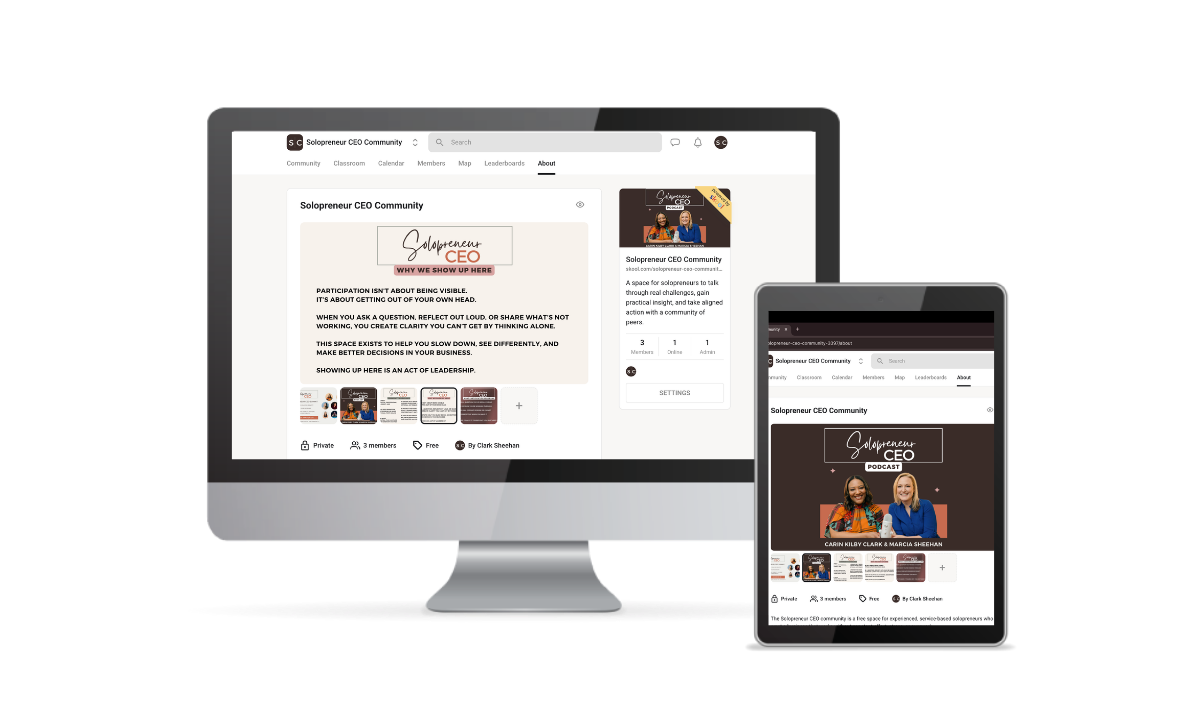
If this episode made you rethink what you actually want your business to look and feel like… you’re not the only one. This is exactly the kind of conversation we’re having inside the community every day.
👉 Join us here: https://thesolopreneurceo.com
A space for solopreneurs who are building real businesses and want camaraderie, perspective, and real conversations along the way.
Episode Transcript
Solopreneur CEO Show Episode 21 Below is the full transcript of this episode for those who prefer to read or want to revisit specific parts of the conversation.
===
Speaker 2: Welcome to the Solopreneur CEO podcast. I'm Carin Kilby Clark, and along with my co-host Marcia Sheehan, we help solopreneurs lead with clarity and build businesses that grow without burnout. This show is for solopreneurs who've built something real, but are carrying more of the load than they want to be.
Your business works, but it depends too heavily on you and deep down, you know it shouldn't feel this hard. Here we talk about the mindset, systems, structure, and support it actually takes to run a business without sacrificing your wellbeing. We are not about hustle culture or pushing harder just to survive.
This podcast is about stepping out of reactive solopreneur mode and into CEO level leadership so your business can support your life instead of consuming it. If you are ready for honest conversations, real world strategies, and a lot less [00:01:00] pretending you are in the right place. Let's get started.
Marcia: This is business ownership, people, okay?
Tara: It all ties in. It's- It's all about business It does. But it, it all ties back- And your
Speaker: values ...
Speaker 2: to powering and your values- Yeah ... and leading with your values, and working with people who share your values. And the only way you know that is if you talk about them. Right. You don't have to have a podcast to talk about them, but you can put it on your website.
You can post it on your social media or put it in your newsletter, so then you attract the people that you want to work with. Yes ... am I going to optimize my website for Claude and ChatGPT? No because I don't want people using Claude and ChatGPT to find me. That's not a good fit. Yeah. Right?
Speaker: Right
Speaker 2: That makes no sense. So, you just... Yeah, it's, it all goes back to alignment, and values, and audacity, and empowerment, and [00:02:00] all of that. It all ties in. We're not- Exactly ... we're not off the rails, Marcia. We're right
Speaker: on track. Okay, good. Good, 'cause I never know. I never know.
Speaker 2: We'll go with it.
Speaker: This is, this is definitely going off the rails, but I thought about it yesterday. So I feel like when authors have a ghostwriter and it's so apparent- Yeah ... like, I feel like that is kind of like AI, I recently started writing fiction I always knew I was supposed to be a writer, I just love the fact that I know you, 'cause I'm like once I'm ready to get to that point, like, I do want a human editing it. I don't want- Yes ... to feed it into the slop machine I'm keeping all this, like, pure in my brain, you know, and, and on a Google W- Which al- which makes me paranoid too, but whatever.
Um- Well, I know. Ugh ... yeah. It's like you just don't... Yeah, there- I know ... you can't really trust anything now, but I'm like- I know ... I can't have it on a notebook. This is just a side thing that I'm doing just for my own fulfillment and- when you, when you hear of authors having ghostwriters or they're writing books using AI and all of that, it's like, "Why? [00:03:00] What is the point?" I don't know. It just seems so like- I know ... it's like processed food, right? It's like not-
Speaker 2: Ghostwriting is the precursor to generative AI, and people- Okay
certainly have opinions on if it's, quote, okay or not. Um, yeah. I don't know. I haven't thought about ghostwriting in a long time, to be honest with you. If you can tell it was ghostwritten, that means that it was poorly ghostwritten, 'cause it's supposed- Okay ... to be in the author's voice- and style and sound like them, right?
Like, if-
Speaker: Yeah ...
Speaker 2: if you wrote or if you read a book that I supposedly wrote and it was extremely formal and had no emojis or exclamation points, you would know it's not me, and that means it was poorly ghostwritten, and poorly edited by me because I should have caught all of that. But yeah, I don't, I don't know if I have a, [00:04:00] a good well thought out opinion on that right now.
Okay. Yeah, yeah. But I'm gonna be thinking about it now, because I mean, ghostwriting, ghostwriters still use their brains. Yeah. They're not using a robot. But they are writing in place of someone, which there could be many reasons for that. Many- Yeah ... many, many reasons. Time, ability. Capacity, yeah.
Capacity. Like, learn- learning disability. Like, yeah, I see. So many things. Yeah. Yeah, yeah, yeah. Right. So I don't wanna make, like, a blanket statement without... Imagine that. I want more information before I can- ... form an educated opinion. Ha, ha. Love it. Love it. Um, I will say, like, there, the big difference is that ghostwriters use their brains.
Generative AI does not. Like-
Speaker: Yeah ...
Speaker 2: and it's just regurgitating everybody else's IP that was stolen to build it. So that's the main difference I can come up with right now, but-
Speaker: Yeah ... I'm gonna
Speaker 2: be thinking about that. Thank you, Marcia.
Speaker: Anytime [00:05:00] you want things that I have questions about, yeah, I- Oh,
Speaker 2: please.
Speaker: I have questions, right? Yeah. Like, I'm very curious. Yeah. So I just love working with people where they are an expert in what it is that they do. I mentioned you at the retreat that I went to, and the facilitator, he's been doing it for, like, decades, and I was like, ", one of the members of my society, she has a membership and it's all with editors."
And he was like, "Well, what do you mean?" And I'm like, "What do you mean, what do I mean?" He was a writer facilitator. Okay. I don't know much about, like, I haven't been in that world for long enough to- stereotype anyone Sure. Sure. Which I probably wouldn't do anyway, but- ... I've seen facilitators where it's kind of like there's, like, a disconnect between-
Speaker 2: Yeah
Speaker: you know? Um, but he- Right ... was just like, "I don't understand what she does." I'm like, "Well, she provides support for, like, freelance editors," and like it's- Mm ... it's literally in the title. Like- Yeah ... Freelance Editors Club. It's like a, a me- a me- membership. Like, I don't, I don't know how to ca- [00:06:00] Anyway, so-
Speaker 2: Yeah.
Yeah, yeah ...
Speaker: um, but
Speaker 2: I was saying that- Well, there's still a lot of mystery about what editors do.
Speaker: Oh, I'm sure, yeah. A- Well- ...
Speaker 2: lot of people don't know the different types of editing, the different types of editors. That is- Right ... still very common to not know.
Speaker: Yeah. Yeah. , That was part of the, the retreat that I loved, was like learning that you can actually have an editor who can help you with, like, the flow of your...
What are they called?
Speaker 2: Yes.
Speaker: It's, like, a architect's editor or something, or no?
Speaker 2: See, there's all these new terms coming out, too. Okay. Yeah. Like, back in the day, uh, if you're talking about, like, plot and, and setting and, like, the, the meat, that's a developmental edit-
Speaker: Okay. Yeah ...
Speaker 2: by a developmental editor. Excuse me.
If you're getting into sentence structure and style and voice, that's line editing. You're talking about- Okay ... grammar, spelling, punctuation, fact-checking, that's copy editing. And then proofreading- Okay ... is the final check for any, like, last remaining typos and errors that happen. But then there's a- Yeah
whole bunch of other stuff, too. Like, there's, [00:07:00] it's a- Yeah ... multi-level process, but people are just, who don't know just will be like, "I need my book edited." And it's like, that's a loaded quest- Like, what does that mean? And then that's where- Right ... we come in, with the education.
Speaker: Yeah. Which is good.
'Cause it's like, do you want it edited so that it can be pitched? - Exactly ... it can, yeah. Like- Yep ... yeah.
You're, such an advocate for editors to stay in business. Because for me, being a human is gonna be the cheat code in the future.
I do branding and marketing that's my business that I have. But I hired a duo in the area, 'cause I met them at a networking thing and, one of them was just very colorful and wearing bright clothes and, like, fun earrings, and, you know, we were having a conversation.
I ended up hiring her and her partner to help me with my personal brand because I couldn't do it 'cause I was too in it- Uh-huh ... you know? Yep. And I'm like, "Can you give me some clari- " people are always gonna hire other people. Especially at- Mm-hmm ... the level that we're at where it's, [00:08:00] solopreneurs, small businesses, mom and pop shops.
Like, sure, you can have AI create a month's worth of social media, but you know what? People are gonna scroll right past it because- Uh-huh ... it's social media slop, and people, like, people underestimate... 'Cause, like, right now there is still some independent thought and there's some- ... intellectual processing going on.
Yeah. Like, maybe five years from now people won't know the difference. Gone. But then we're gonna be- ... being sold to in some other way, you know? Anyway, okay. Um- Yeah ... stay focused. I want to talk to you about how you run your business, 'cause , you have multiple parts of it.
You have the membership, you're actually an editor, and then, I mean, you're a mom or you're a wife, you're very involved in your community. What does any given week look like? And do you- Do you plan on... Sorry, I'm like the queen of mul- No, it's just funny ... many questions at once. But, like- Love it
do you ever plan on, like, hiring anyone or, like-
Speaker 2: So
Speaker: I, I do ... growing [00:09:00] your business? Okay.
Speaker 2: Yeah. Uh, well, yes and no. Um-
Speaker: Okay ...
Speaker 2: yes, I am all the things that you said. Any given week is a crap shoot. Because I have kids, they get the disease of the week from school or daycare, things happen. But I typically work a tr- traditional hours, um, typically.
So that for me right now, that looks like about 9:00 to 3:00 while my kids are at school and daycare. , But I also sometimes will work in the evenings after they go to bed depending on what's going on. I try not to, but there are just seasons where you kinda need to, which I'm in right now. Most of the time I don't work the weekends, but again, if the situation calls for it and the kids are off doing their own thing, which is great and whole nother level unlocked in parenting, I have to tell you.
They can just play independently. I'm like, "Ah." Uh, but it's a, it's traditionally like that. And then I have, let's see, throughout... I've hired contractors, [00:10:00] let me just say that, throughout my business. Right now, I'll just say right now. Right now I have a podcast producer who edits and does all the back-end zhuzhing with the podcast. Writes the blog posts, generates the transcript, edits the, episode and all of that.
I, of course, edit all of it 'cause, hello, what I do. But her and her team do that. And then I have sort of a project manager, VA kind of a situation who helps me with some of the admin-y stuff with the club on a monthly basis. I had someone I was paying to help me with SEO. Excuse me, which is a bit on hold, 'cause I just launched a new website.
So I have people like that. I just built a new website and hired someone and had a branding project. I don't ever, as of right now, think I will hire any- anybody, like an official employee of Tara Whitaker Inc., uh, 'cause that does not sound appealing to me. I don't wanna manage [00:11:00] anybody. Um, I don't wanna be, uh, uh, what's the word?
Words, Marcia. I don't wanna be-
Speaker: Supervising
Speaker 2: Yes ... micro managing,
Speaker: supervising.
Speaker 2: Yes. Yes. Um- I don't want, I don't want someone reliant on me. How's that?
Speaker: For work, right?
Speaker 2: For work, right. Yeah, I
Speaker: feel like, oh my God, like trying to like... And I get that's why like a lot of companies suck, because the people are like, "Oh, well I gotta give them work because I'm paying them a salary."
And it's like- Right ... sure.
Speaker 2: Right. Yeah. Yeah. And, and I am, you know, I... This is something that I've worked through a lot through the years, 'cause when I started this it was all, you know, oh, well, if you're gonna scale, if you're gonna make six figures, you know, all these buzzwords. You know, you've gotta hire and you gotta do this.
And it's like, okay, that's fine, but what if I'm happy with just making whatever that amount is? And, yes, full disclosure, I would like to make money, and I do make money because I am not independently wealthy nor do I have a trust fund or anything. So I have to [00:12:00] work to make money, but I'm not looking to be the next like, I don't know, big time, big shot entrepreneur that makes 28 figures.
Like, not because I have imposter syndrome, it's 'cause I just don't want that responsibility or that visibility. I wanna make an impact in my own little niche and my own little corner of the world, and I wanna make money, and I wanna help people, and support my family, and that's good. It doesn't have to be nine figures and have a roster of 40 employees.
Like, that sounds horrendous to me. I would rather make far less money and it just be me and some chosen contractors that I like to work with. Am I selling myself short? I don't know, but- I don't know ... it's a lifestyle choice too. Yeah. I don't wanna work all the time. Yeah. Nor do I wanna be responsible for all these other people and things.
That just... I don't, I don't know.
Speaker: That's what a capitalistic society ingrains in everyone. It's like you [00:13:00] have- Yeah ... to be constantly proving your worth we're constantly being told that we're not enough, so the way that you- Oh, yeah ... counter- counterbalance that is by showing that you are by having all of these material things. Once you can break loose from that- thought about, "I just need to work really, really, really hard now to make a lot of money so I'm set up for the future."
But what are you compromising in the current situation? Your ability to be there for your kids and knowing that like, hey, they're at the age where they're gonna be bringing home, you know, funguses and like- They're like Petri dishes, right? Like, your kids are- Oh my gosh ... literally Petri dishes right now.
They are. Yes. So, so you having that ability to just go with the flow, like, it's so frustrating, and I know that because I, I went through that with my kids. I wasn't making money though. I was working and not making money, and, you know, working on my minds- money [00:14:00] mindset. Like, that's been a whole thing.
The things that are happening in my family right now, I have the ability to be there completely emotionally- Mm-hmm ... for, for everyone, you know? And it took me a while too, and it, it really is, like, it's an unlearning. It's an unlearning- It is ... to realize that, like, you can be okay with enough.
You don't have to strive. And, yeah. Mm. I just, you know, I- That, you need to put that on a quote. It's okay to have enough. Yeah. It really is, 'cause like I, I had the conversation when I worked at the government agency in my, like, late teens, um, till, like, 23 or whatever. But my dad worked at the same agency, and we had a lunch one day and he, like, started crying.
And he was like, "I just feel like I was never there for you and your sisters." Oh. "And I regret that." He's like, "That's the biggest regret that I have." I had, a stay-at-home mom, and I'm not trying to trad wife anything here. Like, me not making money, like, you know, like, that's not- Yeah.
I think you should do whatever you wanna do, [00:15:00] but I do think that at some point, the expectation that you have that the world wants you to reach a certain dollar amount, you're gonna realize as you get older like, "Oh, that was not real." Yeah. And then you're gonna look at your relationships and your community and your life and you're gonna be like, "Wow, it's really, really quiet right now, and I have a lot of regrets."
Yeah. So, it's like slow the fuck down. Like...
Speaker 2: Yes.
Speaker: You know? Yes.
Speaker 2: We're so focused on the quantifiable things, like- Yeah ... the amount of money and the da, da, da. And I, you know, real talk, yes, I used to be motivated by that as well, and I still am to an extent. Yeah. Because again, who doesn't love money? Yeah, me too.
Like,
Speaker: yeah, we like
Speaker 2: money.
Speaker: Like, I- Look, I, I'd love to have, like, the tree in my backyard cut down, but-
Speaker 2: Oh my gosh ...
Speaker: can't afford it right now.
Speaker 2: 100%. 100%. But then also, realizing that the unquantifiable things, like impact and being there for your kids and having flexibility and- showing up as your [00:16:00] best self as a parent because, oh my gosh, I don't know about you, but parenting my kids has also been a massive lesson in parenting myself and parenting my, my past childhood.
Um, maybe even more so than parenting my own children. But that takes a lot of mental and emotional capacity, and I would rather spend that on those things than aim for some arbitrary dollar amount that someone has said that is the goal. Like, that's not what's gonna satisfy me through my life, and that's not what I'm gonna look at at the end and be like, "Oh, I'm so glad that I made all of this money, but my kid is a wreck," you know?
Like, let's, let's put this in perspective here.
Speaker: Yeah. Yeah, I'm glad we're having this conversation 'cause it's something I think about a lot, but I don't actually talk about it because I never want it to be, like, judgmental. 'Cause there are people- Right ... who, yeah, where it's like ... But I just want [00:17:00] everybody, like, that's my mission in life.
I wrote it down. I have put it in the blog. But, like, my mission in life is for people to have independent thought so that they can use their gifts to make the world a better place. Yes. Yeah. And so, like, the independent thought comes from am I just going through the rat race because society has shown me that that's the only way?
So, like, just think- Mm-hmm ... about the situations that you're in. Like, you don't have to, you know, turn your ... Like, that's why we use solopreneur. It's not entrepreneur. Like, we're not trying to make enterprises. Like, I- Yes. Yes ... when you were saying having 40 employees, I'm like, and you were like, "I'd rather have no money," I'm like, "I'd rather live in a cardboard box than, like-"
have to manage other people, you know? Like- Yes ... I have a hard enough time managing myself. And, like, it just, my energy and my capacity, like, it's just not for me.
Speaker 2: No. No. It's like- And that, and that's okay. Yeah. And, and like what you said, if ... I'm not saying I'm anti-money on [00:18:00] any level. No. Um-
Speaker: We love money.
Speaker 2: God, we love money.
We love women having money. Yes. We love marginalized people having money. Yes. We love all of the money to, because we know that we use it for good- Right ... and
Speaker: not to
Speaker 2: buy social media platforms or-
Speaker: Yeah ...
Speaker 2: you know, all of that. So yes, money. There's a quote
Speaker: th- there's a quote that says, um, "Bad things don't happen when women have more money."
Nope. So I will say that that- Nope ... is where my want for money- Mm-hmm. Yes ... it's so that I can spend it on things. Yes. It's not to buy a yacht. It's not to- Uh-huh ... have a private jet. Like, I feel like, you know, I can make a, a, a nickel scream. So, like, I would still be- Like if I were to have like a windfall, you know, my, my novel turns into like a mini series- Absolutely
you know, Netflix or whoever. Heck yeah. Yeah. Then it's like- Why not? But like I would just, you know, maybe charter a plane instead of just buy a plane. There you go. Or you know, so it's like- Yeah ... it's, yeah, [00:19:00] like there, there are ways- ... that you can, yeah, use your money for impact. Yeah, we're definitely not saying like, "Don't make money."
Like money- Yeah, yeah ... is good. We love it. But- Exactly ... don't have that be like what you think is, "I'm gonna reach this goal, and then I'm gonna be fulfilled."
Speaker 2: Right. Right. There's lots of different goals, and none of them are better or worse than another. They're just yours, and they're all okay, and they're all valid.
Speaker: My dog started talking. So- ... or talking, barking. You were one of the first person to join the Success Secret Society. I- Yay. Can you share in a couple words like why you decided to join?
Speaker 2: Yeah. So obviously, talked about having my own community.
Being a community facilitator or moderator or whatever is amazing and I love it, and I don't see myself changing that anytime soon. And I was also looking for a community that I could be a member of and participate in on that level, and not have to organize it, plan it, run it, et cetera. And [00:20:00] again, we've known each other for how many years now?
I knew you're legit. I was so excited to see that you had Carin on board or like you were teaming up, and so it was kind of a no-brainer. Um, I will be transparent though, and you know, you know this too, I have found the switch from being a moderator or facilitator to a member difficult. Which has also been very interesting and enlightening because it's helped me recognize how some members in my community might be feeling about participating.
A- and I'm not scared to participate. It's not, um, it's not anything like that, but it's setting aside the time and making sure that I am a participant and an active participant, and I promise I will be better at that in the future. Also, time zones are a pain in the butt. Yeah. I'm just gonna throw that out there.
In many ways. But yes. Um, but the people in the community are amazing, and people that I look up to and want to learn more from. So yeah, I'm just pumped to be a part of the group. [00:21:00]
Speaker: Thank you for that. And I, I agree too, like being at that retreat, 'cause I've led retreats, I'm like you, you see the facilitator and you're kinda like, it's like you're kinda gleaning like how you can do things different- Yeah
but also like, "Okay, I'm not here to lead. I'm here to participate." Right. So- Right ... which, which is good. Like we need that. We need those safe, supportive spaces that we know- are there and available for us. So-
Speaker 2: Yeah ...
Speaker: thank you so much for being here. I know you have a, a meeting, so I wanna- Oh, thank you for having me
respect your time. Yeah, this was amazing. Thank you so much, and we will see you next week. Bye.
Marcia: Thanks so much for spending time with us today. If this episode made you feel seen or helped something click, join our free community at thesolopreneurceo.com.
This is a space to connect with other solopreneurs who are building sustainable businesses and don't wanna do it alone. If you found this conversation helpful, leaving a quick review helps more people find the show and reminds them they're not the only ones [00:22:00] feeling this way.
We're really glad you're here and we'll see you in the next episode.