
Episode 3: Capacity Isn’t a Time Problem: Why Your Business Feels Full Before It’s Grown
If you feel like you never have enough time, you’re not imagining it.
But time might not be the real issue.
For many solopreneurs, capacity problems get mislabeled as time problems. You try time blocking, buy new planners, experiment with productivity methods, and still feel maxed out. The business feels full before it’s actually grown.
In this episode of The Solopreneur CEO Podcast, Carin and Marcia unpack why capacity is not the same thing as time and why managing your calendar won’t fix a structurally overloaded business.
Capacity isn’t about how many hours you work.
It’s about how the business is designed.
Listen to the Episode
In this conversation, Carin and Marcia take a closer look at why solopreneurs so often feel at capacity even when they’re doing all the “right” things with their time.
They talk through how complexity quietly creeps into growing businesses, how decision fatigue and mental load drain capacity faster than hours on the clock, and why unclear communication, onboarding, and boundaries turn the solopreneur into the default for everything.
You’ll also hear why capacity issues can create subconscious resistance to growth. When your business isn’t set up to support more clients, you may find yourself avoiding sales, saying no to opportunities, or feeling anxious about growth instead of excited by it.
This episode is about designing a business that can grow without exhausting you, not by doing more, but by simplifying how the business actually runs.
What We Talk About In This Episode
Why capacity problems are often mistaken for time problems
How business complexity limits growth even when you manage your time well
Why planners and productivity tools don’t fix structural issues
How unclear communication and onboarding drain your capacity
The hidden ways solopreneurs become bottlenecks in their own business
Why client capacity matters just as much as your own
How to start creating capacity without burning everything down
Key Takeaways
Capacity is a design issue, not a scheduling issue.
Time management can’t fix a structurally overloaded business.
Decision fatigue and mental load quietly limit growth.
Clear communication and boundaries protect your capacity.
Simplifying how the business runs creates room to grow without burnout..
Continue the Conversation
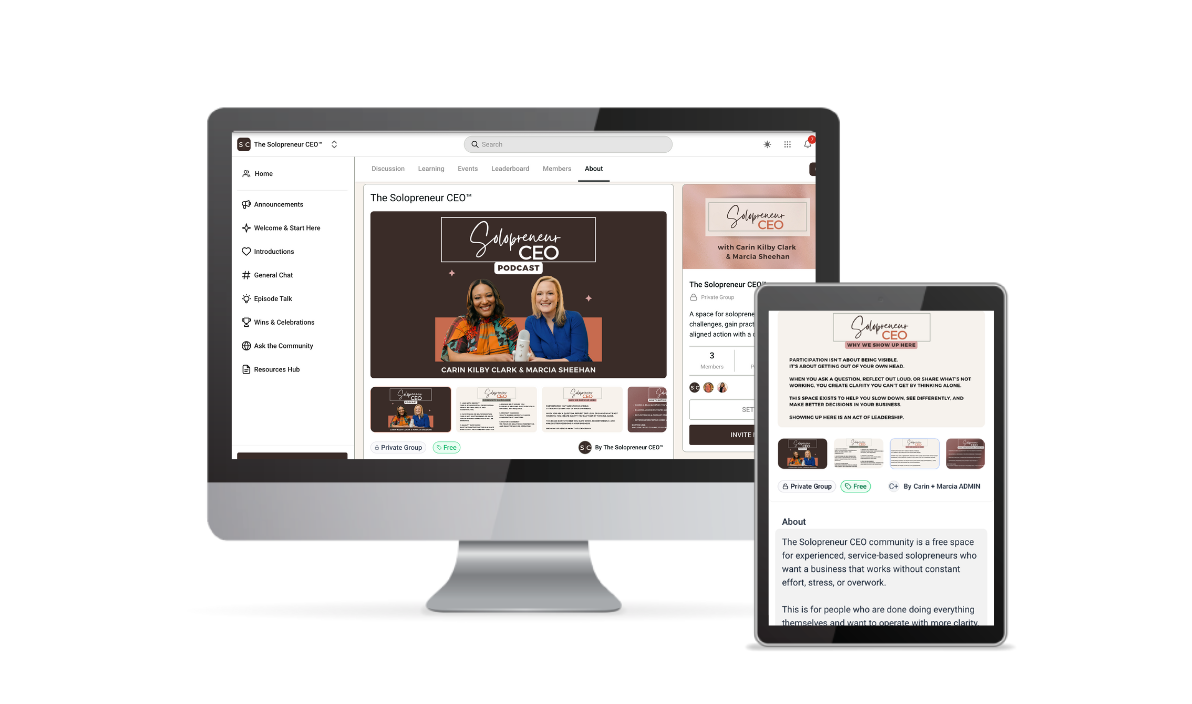
If this episode made you feel seen or helped something click, you’re invited to join our free Solopreneur CEO community.
It’s a low-noise space for solopreneurs who want support, honest conversation, and a better way to build a business that works without burning out.
Episode Transcript
Solopreneur CEO Show Episode 3: Below is the full transcript of this episode for those who prefer to read or want to revisit specific parts of the conversation.
===
Carin:
Welcome back to the Solopreneur CEO podcast. We had our first couple episodes and hopefully you were able to soak those in. We talked a lot about systems and the mindset around systems. In our last episode we briefly mentioned something around onboarding.
We wanted to go a little deeper in this episode about capacity because a lot of times when we're talking with our society members or just kind of spying on what's going on out there, on the interwebs, in our niche, we see a lot of people complaining about time. I don't have enough time or there's always so much to do.
I just don't have the capacity. 'cause the point is they want to grow, right? And you probably are the same. I mean, I think we all want to grow. It's never anything wrong with wanting to grow your business. But you always face the reality of, what is my capacity though? I can't grow past what I'm actually able to do.
You're a solopreneur, right? We talk about this all the time. Wearing all the hats, doing all the things. So capacity is a real thing, but sometimes, or oftentimes, we equate capacity problems to time problems, and that's not necessarily a direct connect. That's what we're gonna talk about in this episode- why capacity is not always a time problem and like, what is it really?
What does it really mean to have capacity to grow your business while still having the business that you have now? Whatever level you're at, whatever income you're pulling in, however many clients you have: you of course wanna maintain that, but you also want to do more.
So what does that actually look like? And how do you actually create capacity for more and be able to grow your business while still being the Solo CEO? That's what we're gonna get into today.
Marcia :
This is such a good conversation because I am a big proponent of time blocking, but if you're time blocking and you're not actually able to get into that deep work, it's not gonna be beneficial for you. Or the business.
That's another common theme that we talk about a lot is changing from the operator mode to CEO and designing your business in a way where it's going to serve you as much as it serves your clients.
If your capacity is strained, then it leads to exhaustion. It leads to putting out fires instead of making the systems run better and basically conserving your energy in a way that is gonna serve you so that you're doing the best work that you can do.
Carin:
The more that your business grows, it can feel it's getting more complex. And really what you want it to do is get simpler and get easier and flow better. So that's a good place to focus your time and your attention. And when you're doing your time blocks and getting into your deep work ask yourself, how does my business actually function? How is it structured? Because a planner is not gonna solve the problem, right? A Pomodoro timer is not gonna save you. But sometimes we'll go to those kind of quicker, easy to pick up fixes. “Well I just need a different planner system, or I just need to try this time system. We focus on managing the time because the time is the thing we can see. You got 24 hours a day, you're working nine to five, and whatever time that you dedicate to your business daily. Time is an easy thing to grab onto and try to fix because it's right there in front of you. How much time you have.
But the capacity is kind of a quiet sleeper cell because no matter what you're doing with the time, if you're not kind of thinking about the structure and how your business functions, the time cannot fix the capacity. The capacity will still be an issue if your business is complex, if you've got a lot going on, even if your decision making framework and mental load is too complex it is gonna affect your capacity.
Once you look under the hood, or peel back the layers, it really becomes: is this a thing I need to work on, or not?
So when you hear me talk about planners, I am always like, why did I buy yet another planner? It's not gonna fix my problems. No shade, if you are feeling that. 'cause it's easy to do because it's again, right in front of us. So you're like, I can fix that right? But it doesn't fix the underlying thing that's holding you back from growing.
Marcia :
You're talking to me too 'cause I have the same planner addiction. Well maybe not as intense, but I love a good planner and a good journal. This is a completely random side note, but I follow this woman who does all of these guided trips throughout the whole world and she had a reel about the different bags that she has. And so there's all these different travel bags and compartments and everything.
When I saw it I was like “oh my God. I just assumed that everybody was a planner addict.”. Then I realized: oh, travelers are bag addicts and writers are journal planner / addicts. Right? And travelers are probably thinking everybody has this many bags.I have two travel bags. That's it.
I love this conversation because when we were discussing recording, we started talking about how if you don't have the clarity and you don't communicate well, if you're not reaching the right type of people, it doesn't matter how clear and concise your onboarding is, there's gonna have be that hands-on touch and so it all works together.
Your marketing and your onboarding and reaching the right clients. It all has to get to that perfect type of person. Because if you're not clear on no, if people aren't clear on what it is you can do for them, and they're not at their own capacity to take on what it is you're going to require from them, then it's just not going to work out. So you need to look at that as well, not just, okay, I need to be spending time on my systems or time on my copy or whatever.
So when you're not communicating things clearly and clients don't know what to expect, then they're going to be coming to you for clarity.
And so you are always gonna be the default to answer everything. So what we're trying to help you do is. Communicate these things in advance so that you're not the default, so that there's not that constant access to you and that there is that boundary.
Carin:
I think what we're saying too is the reframe and how you are looking at your capacity. It's not about how much you can personally do. We talk a lot about systems and setting up your business so that it can run without you doing every little thing.
So it's important that you also think, “How can I make it so that the clients don't have to come and ask me all the questions?” “How can I make it so that everything is clear, they get what they need. And I don't have to go and press a button.” Because then you will lean in to getting more clients. A lot of times you'll have a subconscious self-sabotage because your capacity is at its limit.
You're not going to be out there pushing the program, trying to get people to sign up for this, because, in the back of your mind, it might not be at the front of your mind, but in the back of your mind: if they say yes, that is gonna create a swirl in your business because you're not really set up to serve more people.
It's important. We have to really think about our capacity. And I like where you mentioned, Marcia, the client's capacity. A lot of times when clients are hesitant or not saying yes, it could be that they aren't sure that they have the capacity to show up and do what's probably gonna be required of them to get the result.
So sometimes we have to think about that in our sales and our marketing, to make sure we are addressing that part too. That we're talking about how much time it's going to take and don't sugarcoat it. I mean, for the person who's gonna show up and do the work, it's important that they really buy in to how much they need to show up and how much work they need to do.
It's not that any of our people, you would not do this. But it happens a lot in the bro marketing, where they're like, “oh, it's easy!”. You'll earn money while you sleep and they make everything sound like it's low to no effort.
And it's the opposite. When you sign up for the thing, you're like, “Hold up, I have to do a lot here. And how am I supposed to do that while also still running my business? This is not going to work. Why did I sign up for this?”.
And we never, of course, again, not you, you would never do this, but we don't want to accidentally even give an impression that things are going to be one way but it ends up being something else.
So just making sure there's clarity all around. Clarity for you, clarity for them is the best thing we can do, because otherwise they're going to try to focus too much on time. “How much time do I need to do this coaching with Carin and Marcia?”. And it could be, do they have the capacity to even show up and do the work and get the most out of being in that program.
Marcia :
This is so good. I love it because there's so many parallels to everything that we're going through right now, especially with the free Solopreneur CEO community. We really want people to be in there engaging and we want it to be peer led and us be the facilitators and the moderators. But it's kind of been a ghost town.
We're like, we need to lay the foundation and let people know. And especially since these are all people who are overextended solopreneurs or not, if you don't identify as overextended, you're all people who are our peers. And so you don't have time to mess around.
I think you want direction, because this is a brand new thing. So Carin and I have been talking behind the scenes about how we get this off the ground and let people know that it's a safe space and that they can talk. We need to be providing them with some examples of how the community can support them.
There is going to be that high touch in the beginning because we are laying the foundation and we're showing and leading these people on how to interact with the community. And that is what every business owner does in the beginning. They start out and they're very high touch and they're very responsive, and they're very capable and reliable, and accessible, but that's not maintainable.
So while Carin and I are going through this, we're like, “Okay, well what can we do now? How can we do this in the most succinct and concise way that doesn't end up screwing us up in the future?”.
But that also can be a mindset thing, because I have had a community that led me to burnout. But I can't take that past trauma and put it onto what we have now because there's so many more experiences that I've had so that isn’t going to happen. And plus it's a different type of person that we're welcoming in at this point.
So, yeah, if you do find yourself at a point where you feel you're at capacity or over your capacity, you're not at fault, it's just that you're in the habit of being available. But there are ways that you can make sure that you're not always accessible.
Carin:
That's such a good point. It's that quote, “What got you here won't get you there.”.
Some of those habits and some of the ways that you may have designed the business, based on capacity at the time that you were in startup and getting there mode is not going to be the same. That will take you into your growth and scale phase. Once you get ready to really grow, and you got it where you wanted it to be, “Okay, let's turn up the volume or add gasoline to the fire.”
The same habits are not going to be the ones that carry you through.
Once you realize, “Okay, yeah, I do kind of have some capacity issues.” the first step is really to notice:
Where are you answering the same questions repeatedly?
Where does something sit and wait for you? Because you have to give it some thought energy, you have to give it some time to figure out, or you have to be the one to review and move it on. This is going to be the case for most of us because we're solopreneurs.
But sometimes you might have a VA or other people that are helping with some parts of your business, so some of that work has to go through you and then you become a bottleneck. If you have started to do some outsourcing, you might not feel it's helping free up your capacity.
If it still has to rely on you to review it and look at it and move it forward or whatever it is. And think about your energy. Sometimes we could be doing some things that just light us up. it might be an intense task, but it's something that gives us energy. And then there could be other things that just drain you and you are just like, “oh my God, I never wanna have to do this again.”.
So just think about that, again, just notice right now. Because that can help you think about how you wanna structure and design your business so that you can have more capacity. You can put your energy into the places that you want your energy to be and then start.
If you haven't had a VA yet, there could be some tasks that are ripe for outsourcing. Even five hours a month. I know that does not sound a lot. It kind of sounds ridiculous, you would hire someone to do five hours a month, but it could be life changing to have a VA do five hours a month.
It doesn't have to be big. Sometimes we're like, “Well, I'm not ready to get help because I don't need anyone doing 10 hours a week.”. That's the beauty of outsourcing. You can find some packages that will work best for what you actually need to offload and just get started in little tiny baby steps.
So that's something to think about because it's not going to go away, right? You cant just put your head in the sand. Not that you want to, but you have to put some energy into this space in your business so that you can grow. Because if not, we'll burn ourselves out.
Things will kind of crash and burn, or you'll want to burn it down. It was maybe 2021 or 2022 and there was a whole mass exodus of online business owners who were like, “I'm burning it all down. I'm starting over. This is my Phoenix era.”
And it was like, what is going on?
But you realize so many people built a business based on models and ways of being and showing up that weren't sustainable. And so they were like, “This is it. I'm done.”
And we're not saying you have to have a Phoenix era. Just do some little tweaking along the way and be thinking about it now. We'll help you in the long run and you won't have to burn it down because you will have designed it in the way that works for you.
Marcia :
If anything you’ve read today is that you’re at this point in your business and life go to thesolopreneurceo.com. You can join our free community and get the conversation started so we can help you, you can have a group of peers that can either validate what you're going through, offer up suggestions, or share what has helped them.
Also, when Carin was saying, just hiring a VA for five hours a month, think about having a house cleaner. How much time do they spend at your house and what type of impact does that have on your mental health? So yeah, if you need validation on why VAs are worth it, then maybe think about it in that way.
They can just come in and dust and vacuum and clean some things up in your business. That's something that we could talk about in the community as well. We want to be here to support you so reach out anytime.