Episode 5: High Touch Without Being On Call
If you care deeply about your clients and the work you do, this episode might put words to something you’ve been feeling for a while.
Being high touch is often something solopreneurs pride themselves on.
You’re responsive. You’re available. You want your clients to feel supported, seen, and confident working with you. Especially in the early stages of business, that level of access can feel generous and aligned.
But as the business grows, so do the demands. And at a certain point, constant availability quietly becomes unsustainable.
In this episode of The Solopreneur CEO Podcast, Marcia shares candid reflections from her experience running high-touch communities and mentoring solopreneurs, and what she learned about being deeply supportive without being on call.
This isn’t about caring less or pulling back emotionally.
It’s about redefining what high-touch leadership actually looks like at higher levels of business.
Listen to the Episode
In this conversation, Marcia takes a closer look at how over-availability shows up in service-based businesses and why it often creates more stress than support.
She talks through how unclear expectations and boundaries increase anxiety for both clients and founders, how being constantly accessible creates ongoing mental load, and why many solopreneurs confuse responsiveness with leadership.
You’ll also hear why stepping out of reactive mode can feel uncomfortable at first, especially for solopreneurs whose work comes naturally to them. When being needed becomes part of your identity, setting boundaries can feel like you’re letting people down, even when you’re actually leading more responsibly.
This episode is about clarity, sustainability, and learning how to support your clients in a way that protects both their experience and your energy.
What We Talk About In This Episode
Why high touch is often confused with constant availability.
How over-availability increases mental load and emotional labor.
The hidden cost of unclear expectations and boundaries.
Why clients don’t need immediate access to feel supported.
How structure and clarity reduce anxiety for everyone involved.
What leadership looks like at higher levels of service-based business.
How to care deeply without being on call.
Key Takeaways
High-touch support does not require constant availability.
Over-availability often creates dependency instead of empowerment.
Unclear structure increases anxiety for both founders and clients.
Clarity and predictability are forms of support.
Sustainable leadership protects both client outcomes and founder energy.
Continue the Conversation
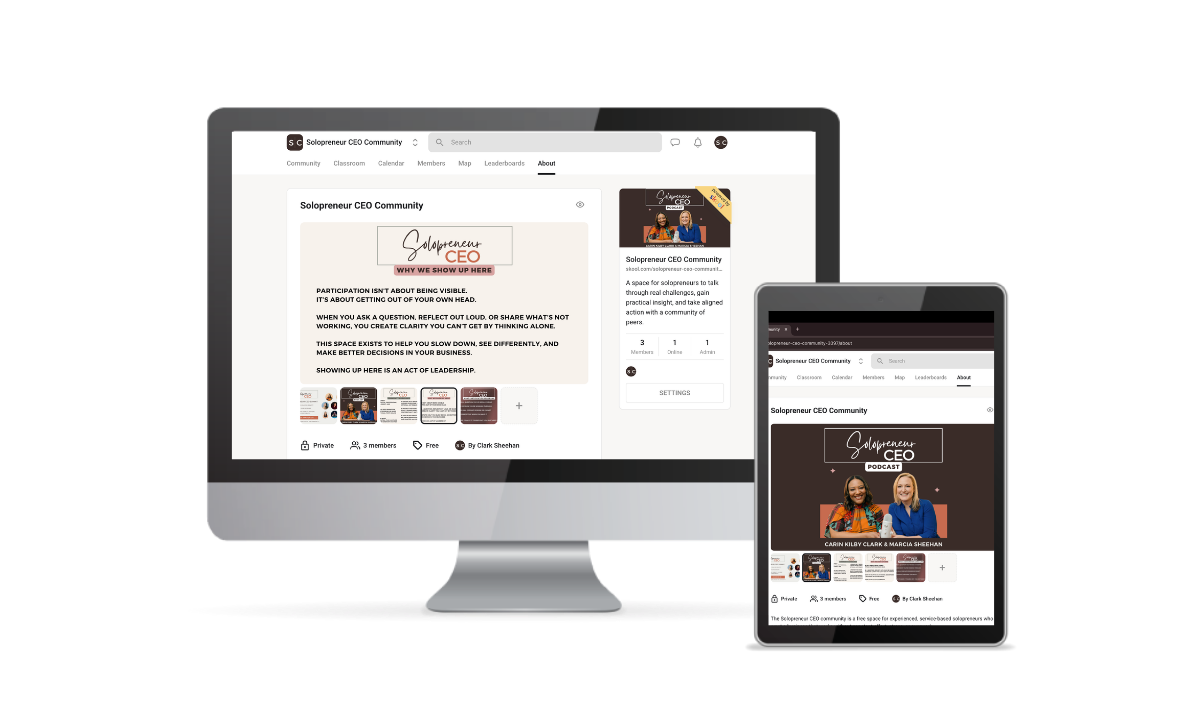
If this episode made something click or helped you feel less alone in what you’re carrying, you’re invited to join our Solopreneur CEO community.
It’s a low-noise space for solopreneurs who want thoughtful conversation, grounded support, and a better way to lead a business that works without burning out.
Episode Transcript
Solopreneur CEO Show Episode 5: Below is the full transcript of this episode for those who prefer to read or want to revisit specific parts of the conversation.
===
Marcia:
Today's blog is all about being high touch, but not being on call.
So giving your clients and customers an experience that feels like you're always in their back pocket, and that you are rooting for them and you're helping them, and you're improving their life and making things easier. Whatever it is you do for them, it's giving them that feeling, but without you actually having to be attached to your email, attached to your phone, attached to your social media, attached to your online community, all of that.
So it's gonna be spoiler alert about systems. Also out of the gate, telling these people how it is you work, communicating what they can expect from you and setting the stage that you are the provider and they're the recipient.
If you know anything about me, you know that one of my values is being thoughtful. I'm the person who gives random gifts. I see something that makes me think of someone, and I know that they'll love it.
Being thoughtful for me, that's part of my identity. And so of course that bled over to my businesses.
Being accessible to everybody at any given moment that's not being thoughtful. That's just basically leading a life that is gonna be controlled by fear of people always having expectations especially if you're an introvert. And it's not even that people have these expectations. I think it's just if you don't put the parameters up for yourself in your business, if you don't have the structure and the operating systems for people to go through, then there's that constant buzz going on inside of you.
It's like our dishwasher. We bought a dishwasher recently. It runs through the cycle. It takes two and a half hours. I realized that once the dishwasher's done going through the whole cycle, it says "end", but the motor's still running. Like there's a hum to it. The boys and I have all trained ourselves anytime we see "end" on the dishwasher, we open the door because I don't want the dishwasher to burn out.
We've been living in our current house for like 15 or 17 years.
When we bought the house, the fridge was so ugly and old, but it literally lasted until two years ago when we bought this new fridge. The old fridge, it still was working, but one of the doors was leaking a little bit. So we bought a new fridge and I had to buy a new light bulb for that 2-year-old fridge, but the other fridge that we had for 13 years that had been here since God only knows maybe the seventies, that we never once changed that light bulb.
Things are made different now. They're not made better. They're made to burn out. With the whole dishwasher thing and the refrigerator thing: maybe that's a good analogy to what it's like being a solopreneur. Where if you are not opening the door to your dishwasher and you have that constant buzzing going on, it's gonna burn the motor out at some point.
One of the things that killed the first society that I had was my lack of boundaries and feeling that I needed to constantly be available.
I realized in 2020, when about half the population realized this as well, that I have ADHD. I traced it back and learned all about inattentive ADHD. I really took a deep dive into it because I recognized how many of the symptoms I had and learned how the brain works and the dopamine and how you're processing things. I've been learning about it for the past six years. It's something that I took deep interest in because I've realized my upbringing and my difficulties in school and my difficulties with keeping a job or not keeping a job, I job hopped a lot. I've been in every industry known to man and I would last maybe 18 months to two years and I thought that was because of my military upbringing. So I was like, oh, I just get the itch and I wanna move on. I'm bored.
With ADHD, one of the common comorbidities is called RSD. It's rejection sensitivity dysphoria. If somebody provides you with feedback, it can make you unhinged. And it might not even be bad feedback, it might just be, "Hey Marcia, I noticed that so and so is making all of these posts in the group, wishing people happy birthday. Is that a good idea?"
Basically from there, spinning out and then shutting down the society.
I know now what I know and the feeling like I needed to constantly be available, and if people were texting me and if people were emailing me, I would receive those messages, if I didn't respond immediately it would just be whirling around in the back of my head, like, oh, I need to get back to so and so. Oh, I need to do this. I need to do that. And so I was never really at peace. I was always feeling like I was on.
We have our new membership, the Success Secret Society, and things are run differently. I had to retrain my brain to realize, or not even retrain, I had to train my brain to realize that I don't have to be responding to people immediately. It's not expected. It's not appropriate in some situations. And now, thank God for these software developers, you can actually schedule stuff to go out in the future.
I drastically decreased my phone time because I realized that it just was not good for my nervous system. I did this, in August or September of last year. I had to put barriers up for myself to protect myself. All of that work started in 2020 after the ADHD self-diagnosis.
I won't get into it, but let's just say when everybody realizes they have ADHD it's not as simple to get a formal diagnosis. But I'm good with that because I don’t want to be medicated.
In 2020 I created a Building Better Boundaries workshop. It helped people go through what their priorities are, what their values are, what people's accessibility to them is, that kind of thing.
This conversation is just a way to tell you that if you are struggling with wanting to be a huge impact in your client's life, but knowing that your own expectation is to always be there to answer. If you're a coach, part of the work that you're doing, or the majority of the work that you're doing, is helping your clients get to the answers on their own.
When you are constantly available and you're giving people the answers immediately in a coaching or mentor type role, then that really disempowers your clients. That's just one way to look at it. Sometimes people need that time and that space to actually work through things instead of having that codependent relationship where they think like, "I'm in pain. I don't wanna be in pain. I know that Marcia has the answer, so I'm just gonna ask her."
Don't do that with Chat GPT either. I feel like that's the new thing. People are like, oh, my coach isn't available so let me just put this in Chat GPT.
Trust your brain. Trust that some things take time to process.
Being high touch without being on call, it's creating that structure and the breadcrumbs along the path that are leading your client to the ultimate goal.
If you're a personal trainer and their goal is to lose a certain amount of weight, you're mapping out that entire process for them. Each time you're meeting with them, you're saying, this is where we've been, this is where we're at now, this is what we're gonna do in this session, and this is what we're gonna do moving forward. So you just give them that next preview.
It's a way to show that you are an expert because they'll see that you already know what it is that they need. So it basically validates like they're not alone in the struggle with whatever they're getting help with.
You know what it is you do. You know the value that you bring, and as long as you have a good history of providing value to people, there's no reason why you can't do that for more people. If you feel like right now you don't have the capacity, it might be because the systems aren't in place where you're basically training the people that you're working with on how to get the best use out of their time with you.
I learned this the hard way. After running my membership from 2015 to 2019. Because I had built that society as something that I needed at that time, everybody who was in the society felt like a peer to me. So I did not feel like a leader. And that showed. People would ask me questions and I would help, and then at some point it just got to be too much. I don't think if any of these members knew how many people were reaching out to me and picking my brain and asking for this and asking for that, I think they would have realized like, oh.
It wasn't by any means, the members. It was me not asserting myself in a way where the lines were clear about what was acceptable.
I think a huge problem with not knowing about ADHD before the society was I had always equated my work ethic with my value as a person, and I always went above and beyond.
That's good if you're working for an employer because you get promoted, you get pay increases. I got a lot of bonuses and promotions because I always went above and beyond.
But when you are a business owner and a solopreneur, you are your own boss and you're probably not that nice to yourself. Because you're busy forecasting for the future. You're thinking, okay, this is how I can grow. You're not thinking about what you've done in the past to get you to where you are. You're seeing the potential and you're working basically 24/7. I'm not telling you to not think about your business all the time. I'm telling you not to think about your clients all the time, like specific clients. I'm saying that if you're gonna be thinking about your business, you need to be thinking about it in a leadership type of way.
Where you're thinking about how you can grow this, how you can put better systems in place, how you can hire out, how you can design a better running machine that doesn't require your 100% availability all of the time.
Any of us that are in business, and it's a business that shares something that comes innately easy to us, like it's our zone of genius. Because it comes easy to you you might have this disconnect that since it's easy for you that you have to go above and beyond. But people really do like to be led. They want to know what the next step is. They have what they want to achieve in mind. They've chosen you to get them to the finish line and you know the steps. And so that's really all you need to be doing is sharing what the next steps are.
Just because you're thinking about your clients doesn't mean you need to be touching base with them all the time. People want results. They don't necessarily want that constant immediate access to you. They just want to know what it is they're supposed to be doing next.
If you've been thinking that high touch means accessibility. You might just need to reframe it.
High touch is actually polite professionalism. It is treating people the same.
High touch is about clarity and consistency. It's about clients knowing what to expect, when to expect it, and where to access what they need to move forward. Notice I said where to go, not how to get to you. When those things are clear, people feel supported, even when you're not immediately available.
Think about your doctor or your dentist, or anyone that you have a relationship with where they're taking care of your health. Maybe it's your therapist. You don't have this expectation of having constant access to them.
You set up your appointments, they tell you what you need, right? Maybe they order you some labs, or they write you a referral or whatever.
So they're looking at your total health, and they're telling you what needs to be done next. That makes you feel confident, right?
You would not think, " I have a headache. I should call Dr. Regina." You would just know that that's just a part of life and that's an ailment, but you know that you don't have immediate access to them even though you're paying insurance, right? Every single month your insurance premium is coming out. But if there was an emergency, just like you as a solopreneur, your clients trust that they would be able to access you.
But the system's in place where it's more of a maintenance and it's they're providing the service that is hopefully gonna keep you healthy or prevent you from disease.
Uncertainty is what creates anxiety with our clients. It's not the inability to access us immediately.
Most of the emotional labor in a service-based business comes from confusion. It's unclear expectations, unclear next steps, unclear boundaries.
When those things aren't defined, clients' default to reaching out. While being reachable might seem high touch, it's not a positive interaction because the client may be frustrated.
"Why wasn't this already laid out for me? How come I have to reach out to them again and find out what the next steps are?"
So at some point, every solopreneur has to ask themselves, not "how can I be there more", but "how should support actually work?" That's the CEO question.
Letting go of constantly being available can feel like you're letting people down, especially if being needed has become part of your identity. No call outs.
Leadership isn't about being indispensable.
It's about building something that works without requiring your constant presence.
We have Success Secret Society members who are also leaders of groups, so they have their own memberships. And the conversation has come up a lot about accessibility and availability and wanting to be a good leader and wanting to provide the members with what it is they need and what they deserve. It's very common for membership leaders to doubt that they're doing enough or that they're giving enough or that they're accessible enough.
There are ways to be high touch without being on call. One of the things that we do with the Success Secret Society is when people join, Carin and I both hand write a card and we send them a logo sticker. And so that is a way for them to get something sweet in the mail.
Being thoughtful is very important. I want the people I work with to feel safe and secure and confident and well cared for. And so ways that I do that is having an open dialogue with them about accessibility. In 2020 or 2021 I actually had a “How I work document”. It was kind of overdramatic and it was intense.
Now I just have a paragraph in proposals and contracts that state: these are the hours that you can expect to reach me.
If it's a one-on-one mentor client, it states specifically when our meetings are when the follow up will be received. And each time we actually meet, I remind them: this is the progress you've made. This is where you're at now. This is the goal that you have. This is how we're working towards it. And I plot it out for them. I tell them how we're going to get there, and I give them those next steps so that there's never that feeling of "Marcia doesn't know me. She doesn't remember me."
Working with solopreneurs, we all are just focused on the goal and how to get there, and we're not taking time to appreciate how far we've come.
And so I make sure to do that with my clients because I want them to know the more you focus on how great you're doing, the more positive energy you're going to get and it's going to help you. It's going to propel you, and that gratitude for how much you've grown is going to make it easier to keep growing and getting to that goal.
We're the lucky ones.
Like sure, there's a lot of shit that comes with being a solopreneur. We have to do everything. Our hand is literally in every single pot. But I wouldn't have it any other way because I have complete autonomy over my future. As long as you know how to sell and as long as you know how to not be an asshole. If you have a good reputation, if you're able to provide a resource for people that improves their life or their business or whatever, then you're going to do just fine.
I hope from this post that you understand that to be high touch, it doesn't mean that you have to be available all the time.
Don't burn yourself out like I did and have to go get a full-time job. I didn't have to get a full-time job because of my business. I did that for personal reasons because of what was happening within our home. And so I was like, I need to get back in the workforce. I need to get a job so that if things hit the fan, there are safeguards in place. I had my two and a half year stint at two different positions and it's not for me. I did love the regular paychecks. I loved having a 403b, and I did like having weekends, like Friday at five, just being like deuces and then having no mental drama around that.
But like what we're building here, what I'm building, what I'm doing, and who I'm helping, it's really impactful. The jobs that I was doing, they were impactful, but it wasn't at the level of what I'm doing now is.
Empowering women to own their gifts and to share their expertise and to do it in a way that is making them financially wealthy and is encouraging their daughters and their nieces and their sisters and all the women around them. Just seeing that there is an alternative way to live. You're building your future and it's pretty cool. So don't burn out. Don't be available all the time for your clients.
Give yourself time away. Do puzzles, go on walks. Book a spa day. You're not ever going to not be thinking about your work, which is fine, but just don't spin out and don't wreak havoc on your nervous system by thinking that you have to be constantly available. Because you don't.