Episode 6: The Decision That Separates Operators From CEOs
If you’ve built your business by being capable, responsible, and good at figuring things out, this episode might name a turning point you’ve been circling for a while.
In the early stages of a business, operating mode works well.
You do the work. You solve problems as they come up. You stay close to every detail to make sure things don’t fall apart. That hands-on approach is often what gets the business off the ground.
But as the business grows, staying in operator mode creates friction. Decisions feel heavier. Everything depends on you. And even though you know something needs to change, it’s not always clear what that change actually is.
In this episode of The Solopreneur CEO Podcast, Carin and Marcia talk about the decision most solopreneurs avoid making and why nothing truly shifts until that decision is made.
This isn’t about titles or hierarchy.
It’s about choosing how you’re going to lead.
Listen to the Episode
In this conversation, Carin and Marcia unpack why so many solopreneurs get stuck in the in-between. They know the business can’t continue the same way, but they haven’t consciously decided what comes next.
They talk through why the operator identity is so hard to let go of, even when it’s no longer serving you, and how indecision quietly increases mental load, complexity, and burnout. You’ll hear why CEO leadership doesn’t mean doing less work, but doing different work, and why that shift often feels uncomfortable before it feels clarifying.
This episode is about leadership, identity, and recognizing that growth doesn’t happen by drifting into a new role. It happens by deciding into it.
What We Talk About In This Episode
Why solopreneurs don’t drift into CEO leadership, they decide into it
The hidden cost of staying half-operator, half-CEO
Why knowing what to do isn’t the same as deciding to lead differently
How indecision quietly increases mental load and complexity
What does the CEO's role actually change in day-to-day decision-making
Why stepping into leadership often feels uncomfortable at first
How intentional decisions reduce burnout and create clarity
Key Takeaways
Indecision is still a decision; it just defaults to operator mode.
CEO leadership begins with a conscious choice, not a title or milestone.
Staying in the in-between creates more friction than committing to change.
Leadership discomfort often signals growth, not failure.
Deciding how you lead simplifies the business more than fixing ever will.
Continue the Conversation
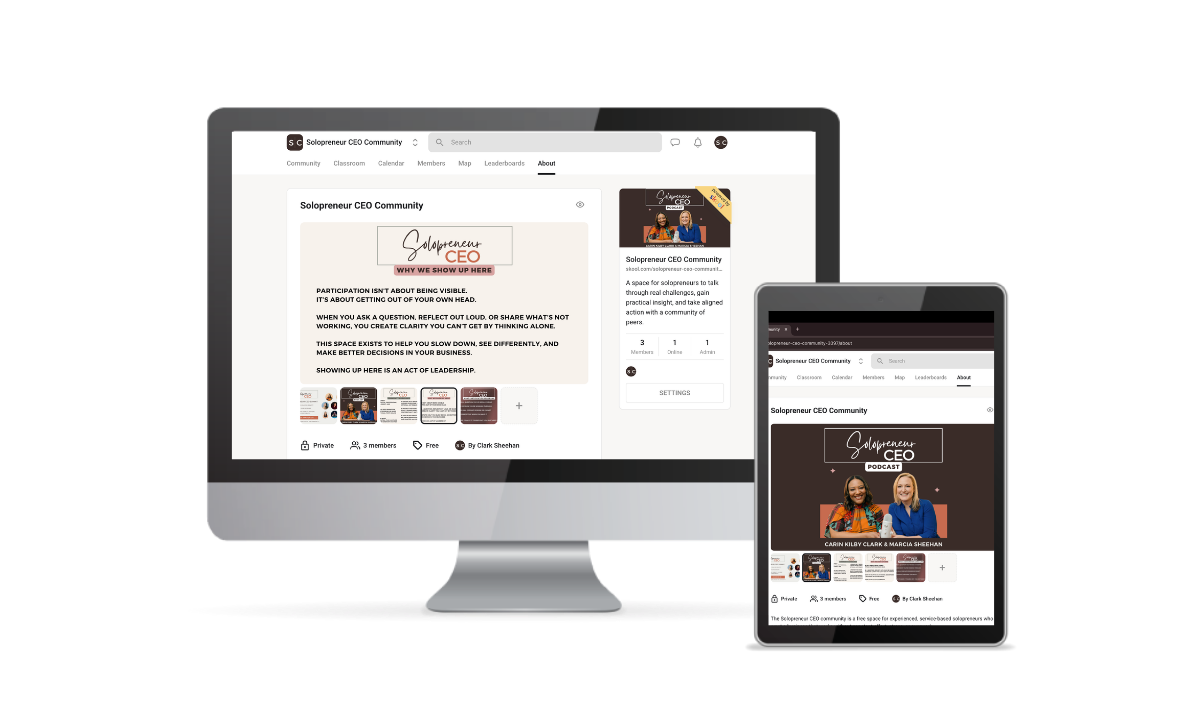
If this episode made something click or helped you feel less alone in what you’re carrying, you’re invited to join our Solopreneur CEO community.
It’s a low-noise space for solopreneurs who want thoughtful conversation, grounded support, and a better way to lead a business that works without burning out.
Episode Transcript
Solopreneur CEO Show Episode 6: Below is the full transcript of this episode for those who prefer to read or want to revisit specific parts of the conversation.
===
Carin:
We are back this week with a co-hosted conversation and we're going to talk about deciding to be a CEO.
It's a really fun topic. It's an ongoing conversation because a lot of times solopreneurs, they don't fail at being in that CEO mode because they're not capable of it. It's not because you don't know how. No one really knows how. Yes, there are tons of leadership books, there's tons of coaches and consultants that will tell you how to be a CEO, but everyone is different.
Every business, although has certain structures and principles of business that are timeless and apply across when you're a solopreneur. Your business is like your little tiny baby that you birthed. And it is special. It is a snowflake.
It is a very personal thing to step into that CEO role, especially if you're not really sure, what does that even mean? What does that really look like? What does that actually change in how I'm moving day to day and how I'm showing up in my business? So today we’re writing about the decision to just start.
Just start calling yourself CEO. Start living in that space, start being in that energy. What does that really look like and feel like?
Marcia:
Something you said made me think about a couple years ago whenh there were badges that said "I adulted today". Being a CEO in your business, deciding I'm not going to just be the operator, I'm going to be the CEO, I'm going to be the leader, I'm going to be making these big boss moves and decisions.
It's like being an adult.
They tell you that when you turn 18, you're an adult. Yeah. In the eyes of the law, right? You can be tried as an adult at that point. But I remember even back into my mid thirties being like, I don't feel like an adult. When am I going to actually feel like an adult?
Because my spirit is young and I'm immature and I'm impulsive. During my solo cast I talked about ADHD and I think a lot of people who are neurodiverse think, I can't believe I'm entrusted with taking care of this baby.
So it really is a mindset thing.
Deciding to become a CEO, it's important to do that. And it's also important to understand that the decisions that you're going to make, they're not set in stone. We have this whole polarized view on everything. If I'm going to be the CEO of my business and I'm going to be the leader in everything and make all of the decisions, I have to nail it and I have to get it right.
That's not realistic at all. You just have to make the decision and then whenever you're showing up, have that be like a pattern disruptor, where if you're doing something and you're like, this isn't something I should be doing, then just take note of it, right?
And then make your decisions and live your life and do your work in that mode where it's like, is this what the CEO would be doing?
Is this what she would be thinking? Am I taking the right actions?
Carin:
I love that so much. And it really is a perfect analogy because I think about how when I was younger, I really wanted to get mail. I just thought mail was going to be like the thing, right?
So whenever I would get mail, I'm like, oh my God, I'm so grown up. I was like, seven, whatever. But when you are actually an adult, you look back and you're like, why the hell was I trying to rush this? Why was I trying to move so fast into this place? So it can feel like that if you're a solopreneur, you might think, well, I don't want to rush into that.
Because once you get there, the CEO role, you don't go backwards, you know? You stay in that energy, you stay in that mode. So it might feel like, I don't want to rush into it. Because then I'm going to be like, maybe it was nice when I was just the operator or just the creative or I was able to just play in those other spaces and feel safe and comfortable.
So it is something you have to take a moment with yourself and decide. What's nice about this, which is different from adulting, is that it's not one or the other, right? You don't get to just be an adult and never be a kid again.
When you're stepping into those CEO's shoes, it doesn't mean you're never going to, especially as a solopreneur, have moments of operator mode or be in your creative space. You're the one that's creating, you have to be in a creative space when you're writing content or creating the products and services that you deliver.
What's nice is that you get to move in and out of those roles when the business needs you to do those different roles. The thing here is that if you are never putting on that CEO hat, if you are never stepping into that CEO mode, your business will suffer for it.
If you are only playing in those other spaces and you are never actually taking that step back and thinking like, how do I want to lead this? How do I want to structure this so that it fits my life and it doesn't take it over? How do I really want the experience to be for my customers?
Stepping away and taking that 50,000 foot view, then your business is going to feel that absence of a CEO whether it's just you or you have a small team or whatever the case may be. You have to play in that CEO space as well. We see so many solopreneurs avoid it because they don't feel like they need to.
They don't really know what that means or what that changes.
It's so interesting when you unpack the whole CEO thing because it's like, Chief Executive Officer of my business of one. It does feel kind of weird.
I talked about it an email I wrote to my list this week about the first time I felt like a CEO. It does feel like shoes that don't quite fit and you're like, why do I need to call myself a CEO?
And we're not saying go change your title on Instagram and put CEO everywhere. This has nothing to do with that. It literally is just a mode that you step into and the way you will make decisions, think about your business, and plan things. That's where that CEO mode is important.
Again, we're not caring about your title. You don't have to go around and say, I'm Carin Kilby Clark, CEO of Time to Thrive. Nobody's listening to that. Nobody cares about that. But in the behind the scenes: am I stepping into CEO mode at least once a week, once a month, a quarter. Like really doing some deep dive planning, thinking about my offers, my community, all that.
I have to. Because if I don't, the business will suffer for it.
Marcia:
That's really good. It also made me think that people on Threads do actually care if you refer to yourself as a CEO and you're just a one person show. I went down a rabbit hole. There were so many comments. It's like: mompreneur. There's certain words that people really dislike. But it doesn't matter.
Carin and I don't care what you call yourself, but we care that you're making the decisions that are going to help the growth and stability of your business.
It's funny because to start a business, you really do have to be in that CEO mindset from the get right?
Because you want to set it up and classify your business in the right way. So you get it registered with the state, you open your business bank account.
You have to do all of these things, right? And it's like very adult. It's very CEO. But it’s also kind of a mix.
You're in the operator mode, but you're also in the CEO mode because you want to set this business up correctly from the get.
I think what happens is just the day to day of running an operation by yourself, you get pulled into the minutia and if you do get to have time off, your nervous system might be trying to recalibrate and just let you rest.
I onboarded a client over the week. It was someone who I had worked with before and their operation is Monday through Friday. I'm not checking that email this weekend. When I worked with them previously, I was checking my email on the weekends. I made that decision before starting to work with this client again.
I talked to the owner of the company and I was like, this is when you can access me. So I gave her an idea of what my schedule was.
Now I don't have the feeling of having to be accessible in the background whirling around my brain.
That's what I want for everyone. I want you to care deeply. And I don't know if I communicated this well in the blog last week, but I want you to care deeply about your clients.
I just don't want them to be taking up the majority of your brain space.
I want your business to be taking up the majority of your brain space.
Carin:
That is such a good point about the mental load, because when you just make the decision to hold some boundaries to design your structure intentionally, it's not haphazard and you're just moving along and things are happening. You're like, okay, I guess I'll go with that. It's really an intentional life first.
I remember when I was first introduced to the Full Focus Planner, which I've been using since it launched.
What I loved about the system was when, Michael Hyatt who created the planner and the whole full focus thing, when he talked about planning your quarter or planning your ideal week or planning your month or your year, he always started with what is going to be happening in your life.
If you have a kid graduating or you have a big vacation planned or whatever it is, blocking that first. And then what are the hours that you want to start and stop? Do you want to work on the weekend?
That was my first time really thinking about that. It's a little different for me now. Marcia knows, I hate those ideal week things now just because so much of my week is taken up by my job. So for 12 hours a day, I'm not here.
But it still is a good practice to think intentionally, even if you're like me and you have some big time commitments that maybe you feel like you don't have control over all of your time.
When you do have time, making intentional decisions and planning around your life, instead of trying to fit your life into the plan. You know, the whole big rock sand pebble thing, if you don't know what I'm talking about, just Google rock, sand, pebble analogy. It should pop up.
Your life is the big rocks. Those are the things that are the most important to fit in. What happens a lot of times if you're not thinking intentionally, not making those decisions from that CEO mindset is your life can just be the, the pebbles or the sand that has to fit around everything else that came first, and then you're un unhappy and you're burnt out and you're ungrateful and you're biting off people's heads.
All the stuff that happens when you haven't stepped back and really taking the time to be in that CEO mode.
It is true. It really does lift mental load. It doesn't sound like it would make a big deal like, I'm just stepping in the CEO mode. And now I have less mental load because you've made decisions and you're sticking to those decisions.
You're not revisiting, you're not second guessing. You're deciding, moving on, and you can tweak. You can tinker and tweak along the way. Like Marcia said, it's not set in stone. But the fact that you make a decision, you move forward and operate under that decision and with that understanding. That removes so much clutter from your mind of back and forth. Do I want to do this? Do I want to do that? Oh, what about this? What about that?
No, that is just a one way ticket to burnout. I want to find a better word, but burnout is the word. And we don't want you to be burned out.
We want you to be energized by your business. We want you to be energized by your clients. We want you to be happy when you see that stripe notification not dreading, oh, great, now I gotta deliver, I gotta do all this stuff because you haven't structured the business in a way that makes that easy for you.
We just want you to be in that energy where your business is fun. It's in line with your vision. It fits around your life, and you're able to serve all the clients you want to serve, whether that's five at a time or 20 at a time or whatever. And it also fulfills you, right?
That you're getting to do the thing that you started your business for in the first place.
Marcia:
We want that fulfillment from the business, not from the busy work that can sometimes make us feel like we're achieving stuff, right? Because I love working, I love getting stuff done. I love it when I hyper focus on something and kind of black out and then four hours later I've done something. I think it was with the summit.
I really enjoyed it and it made me feel really good. But that was operator type stuff. Which is fine. The decision to host the summit, all of that, that was us in our CEO decision making.
So we want the fulfillment to come from having a business that feeds you, it doesn't bleed you. I was going through all my old posts and that was in one of the presentations that I did. We want your business to feed you, not bleed you, and it's true.
You're not going to be in CEO mode 24/7, but take that time. Do the CEO day, put an hour on your calendar once a week. Make the decisions, and then like Carin said, just work towards whatever it is your vision is and then reassess.
You can reassess once a quarter. You can join us for our quarterly workshops where we spend an hour and a half plotting out the next quarter. But we also spend time like, okay, what worked during this past 12 weeks?
It's checking in. It's making the decisions, and it's not getting caught up in the day to day and thinking that you're moving the needle because you're working.
Carin and I have a very specific vision for why we think that solopreneurs can take over the world. Just kidding.
But we think that you can have a lean, mean operating machine. You can do it on your own. You just have to structure it in a way that doesn't have you in the center of it at all times. Like you need to be looking at it from up above.
Carin:
I love that because it's true. You don’t want to be the center of everything at all times. Because that's where burnout comes from. It’s not necessarily like you hate everything or you want to give it up or you burn it all down. It really is that it's too much load on your capacity. It's too much load on your mental capacity, maybe physical capacity. It's just too much load.
Just because you're a solopreneur does not mean you have to be doing every little thing at all the time.
Marcia mentioned our quarterly workshops. We do those with our members, but we do also allow others to join.
We'll never miss an opportunity to invite you to join the Success Secret Society just because we know that it's hard to do this, it's hard to stay in this mode regularly and, and having support is important. So if that feels like it could be aligned, definitely check the link HERE.
We would love for you to join a group of people who are able to just be as we are, show up as we are, dump it out, talk through the gobbly gook, and come to a better place than the other side of it and just regularly support each other in playing in that CEO space so that our business can be a lean, mean operating machine.